

How premium DTF outsourcing boosts apparel businesses
Learn how premium DTF outsourcing cuts costs, boosts quality, and helps apparel businesses scale fast without owning a printer. A practical guide for 2026.

TL;DR:
- Outsourcing premium DTF transfers offers high-quality, durable results without expensive equipment.
- Small and growing brands benefit from flexible, scalable, and cost-effective DTF outsourcing options.
- Choosing a reliable supplier involves testing samples, assessing quality, and ensuring consistent communication.
You don’t need to own a DTF printer to produce high-quality custom apparel. That’s the reality more apparel businesses are waking up to in 2026. The DTF market hit $2.72B in 2024, and it’s growing fast because outsourcing premium DTF transfers gives brands studio-quality results without the overhead. Whether you run a merch brand, a print shop, or an embroidery business, this guide covers what premium DTF outsourcing actually means, what it costs, how it scales, and how to choose the right partner so you can focus on growing your business instead of babysitting a printer.
Table of Contents
- What is premium DTF and how does outsourcing work?
- Why outsource DTF transfers? Cost, quality, and scalability explained
- How to choose the right premium DTF partner
- Pro tips: Maximizing value and avoiding DTF outsourcing pitfalls
- A new era for apparel businesses: Our take on premium DTF outsourcing
- Ready to unlock premium DTF for your brand?
- Frequently asked questions
Key Takeaways
| Point | Details |
|---|---|
| Outsourcing boosts efficiency | Premium DTF outsourcing removes equipment headaches and allows apparel brands to scale quickly. |
| Cost and quality advantages | Outsourcing DTF transfers is more affordable and consistent than DIY for most small businesses. |
| Choose partners wisely | Testing, clear communication, and sample evaluation ensure premium results from DTF suppliers. |
| Avoid common pitfalls | Knowing typical DTF issues helps prevent expensive production mistakes. |
What is premium DTF and how does outsourcing work?
Not all DTF transfers are created equal. Standard DTF gets ink on film and calls it done. Premium DTF goes further. It uses high-grade pigment inks, professional-quality PET film, and precise color management to produce transfers with vivid color accuracy, soft hand feel, and wash durability that holds up through dozens of cycles. The difference shows up immediately on the garment and keeps showing up after repeated washing.
Here’s a quick breakdown of what separates premium DTF from basic DTF:
- Ink quality: Higher pigment density means richer colors and better opacity on dark fabrics
- Film grade: Premium film holds detail better and releases cleanly during heat application
- Color management: Calibrated RIP software ensures what you see on screen matches what lands on the shirt
- Powder adhesive: Even, consistent application prevents peeling and cracking over time
- Durability testing: Premium suppliers test wash performance before shipping
The outsourcing workflow is straightforward. You upload your artwork, choose your transfer size and quantity, and your supplier handles printing, powdering, and curing. You receive ready-to-press transfers, heat-press them onto garments, and ship to your customers. That’s it. No printer maintenance, no ink refills, no film jams.
| Step | Your responsibility | Supplier’s responsibility |
|---|---|---|
| Artwork prep | Upload print-ready files | Color correction and RIP processing |
| Production | None | Printing, powdering, curing |
| Quality check | None | Inspection before shipping |
| Application | Heat-press transfers to garments | Deliver transfers to your door |
| Fulfillment | Ship finished products | None |
This model suits small and growing brands especially well. You get access to custom garment printing benefits without capital investment. And because suppliers handle production at scale, you benefit from equipment and expertise that would cost tens of thousands of dollars to replicate in-house. The DTF market growing at 6% CAGR reflects exactly this shift: more businesses choosing outsourcing over ownership.
If you’re new to the terminology, reviewing DTF terminology for outsourcing will help you communicate clearly with suppliers from day one.
Pro Tip: Always send print-ready files at 300 DPI with a transparent background. It speeds up production and reduces the chance of color or sizing errors on your order.
Why outsource DTF transfers? Cost, quality, and scalability explained
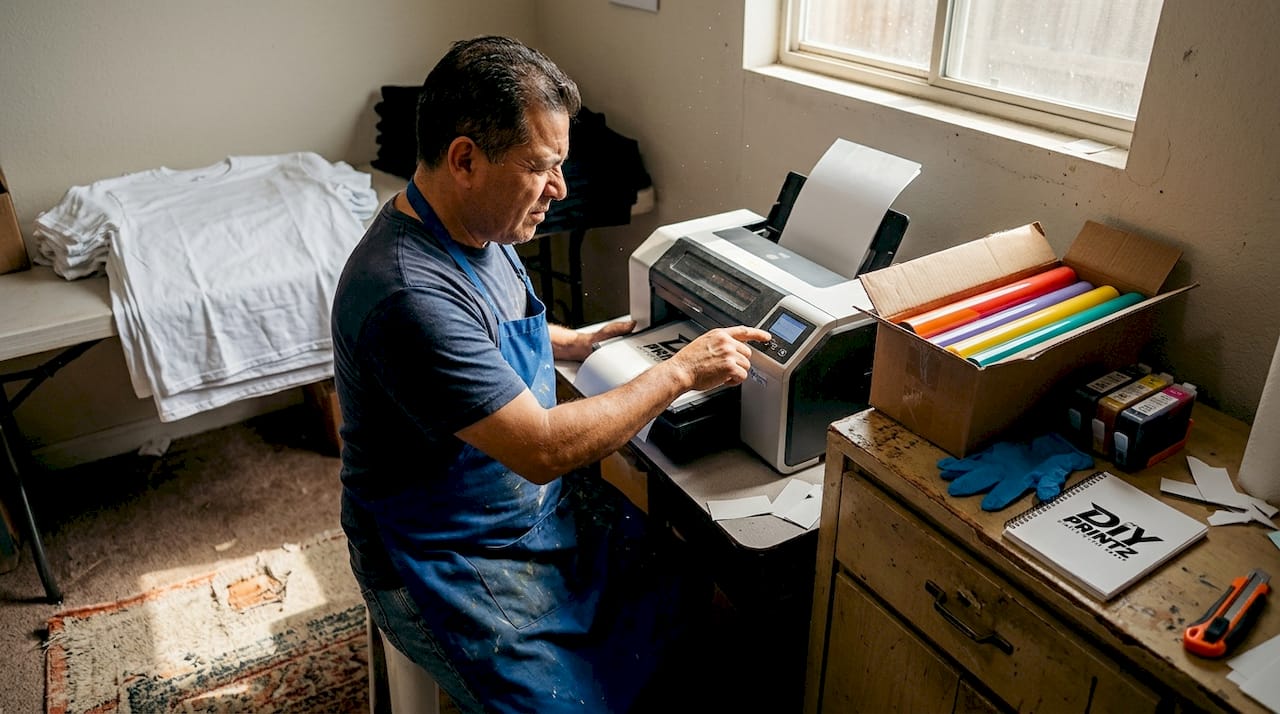
Let’s talk numbers. Buying a desktop DTF printer runs anywhere from $3,000 to $15,000 depending on the model. Add ink, film, powder, a curing unit, and ongoing maintenance, and your startup costs climb fast. Then factor in the learning curve, the time spent troubleshooting, and the inconsistency that comes with in-house production at low volumes.
Outsourcing flips that equation. You pay per transfer, scale up or down based on demand, and never touch a piece of equipment. The benefits of DTF outsourcing are especially clear for businesses doing small to mid-size runs regularly.
Here’s a direct comparison:
| Factor | In-house DTF | Outsourced DTF |
|---|---|---|
| Startup cost | $3,000 to $15,000+ | $0 |
| Maintenance | Ongoing, time-consuming | None |
| Quality consistency | Variable, skill-dependent | Professional, standardized |
| Scalability | Limited by equipment | Unlimited |
| Turnaround speed | Depends on your capacity | Same-day to 3-day options |
| Minimum order | None (but inefficient at low volume) | Often 1 sheet minimum |
For high-volume operations, in-house desktop DTF can generate $500 to $1,000 profit per hour at 50 to 75 shirts per day. That’s a real return, but only if you have the volume to justify it. Most small brands don’t, at least not consistently.
Outsourcing also solves the scalability problem. Gang sheet ordering lets you pack multiple designs onto a single sheet, which cuts cost per transfer significantly. Whether you need 10 transfers or 10,000, a reliable DTF partner adjusts without you changing anything about your workflow.
Here’s how to think about when outsourcing makes the most sense:
- Your order volume fluctuates month to month
- You’re producing multiple designs in small quantities
- You want to offer custom or one-off orders without waste
- You need consistent quality across different garment types
- You want to free up time for sales, design, and fulfillment
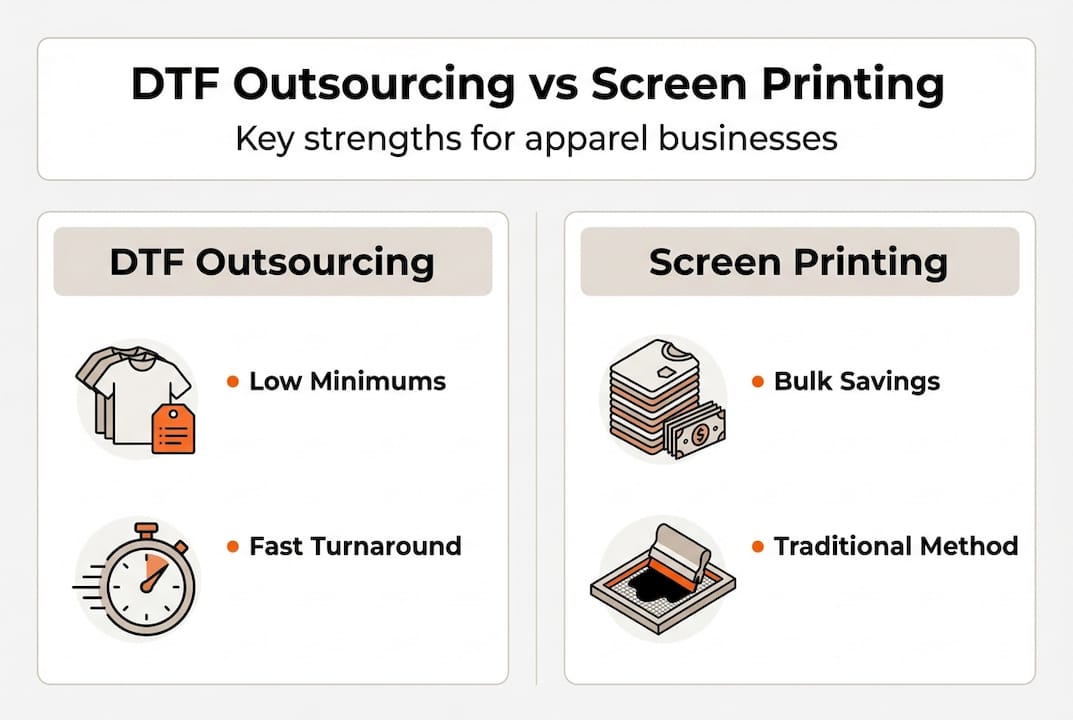
When you compare DTF vs screen printing, outsourced DTF wins on flexibility and low minimums every time. Screen printing requires setup fees and minimum quantities that make small runs expensive. DTF doesn’t.
Pro Tip: Use gang sheets to combine multiple small designs into one order. You’ll reduce cost per transfer and keep your inventory lean without sacrificing variety.
How to choose the right premium DTF partner
Not every DTF supplier delivers premium results. Some cut corners on ink quality, ship inconsistent transfers, or disappear when you have a problem. Choosing the right partner takes a little upfront work, but it pays off in every order after that.
Here’s what to look for in a premium DTF supplier:
- Ink and film standards: Ask what inks and film they use. Premium suppliers use professional-grade materials and can tell you about them.
- Color accuracy: Request a sample with a design you know well. Compare it to your digital file.
- Wash durability: Press a sample transfer, wash it five times, and check for fading, cracking, or peeling.
- Turnaround time: Same-day and next-day options signal a well-run operation with real capacity.
- Customer service: Test their response time before you need help urgently.
- Reorder consistency: One great order isn’t enough. Ask if they can reproduce the same result across multiple orders.
The vetting process should always start with a sample order. Test suppliers via samples for color accuracy and wash performance before committing to bulk runs. It’s a small investment that protects every large order that follows.
Here’s a step-by-step process for onboarding a new DTF supplier:
- Request a sample order with your actual artwork
- Press the sample on your target fabric and wash it multiple times
- Compare color output to your original file
- Confirm turnaround times and shipping options
- Place a small production order before scaling up
- Evaluate communication and support throughout the process
“The best DTF partners feel like an extension of your own team. They catch file issues before printing, flag potential problems, and deliver transfers that make your garments look better than you expected.”
For more context on why the method matters, check out why choose transfer printing for apparel. And if you’re evaluating long-term value, understanding DTF print durability will help you set the right expectations with your customers.
Pro tips: Maximizing value and avoiding DTF outsourcing pitfalls
Even with a great supplier, results depend on how you prep, press, and communicate. Here are the most common issues businesses run into and how to avoid them.
Common DTF outsourcing problems and fixes:
- Poor adhesion: Always pre-press your garment for 3 to 5 seconds to remove moisture before applying the transfer. Moisture is the number one cause of adhesion failure.
- Cracking or peeling after washing: This usually points to over-curing during production or pressing at too high a temperature. Ask your supplier for recommended press settings and follow them exactly.
- Color mismatch: Submit files in RGB or CMYK as your supplier specifies. Always request a proof for new designs before a full run.
- Fabric-specific issues: Fabric-specific temps matter for polyester blends. Lower your press temperature to avoid scorching or dye migration on synthetic fabrics.
- Artwork errors: Bleed zones, low-resolution files, and missing transparent backgrounds cause delays. Set up a file checklist and use it every time.
Pro Tip: Keep a press settings log for every fabric type you work with. Once you find the right time, temperature, and pressure for a specific material, document it. You’ll save time and avoid repeat mistakes on future orders.
Communication with your supplier is just as important as the technical side. If you’re trying a new design, a new fabric, or a new use case, tell them. Good suppliers adjust their process based on your application. Don’t assume they know what you’re pressing onto.
“Most DTF problems aren’t supplier problems. They’re communication gaps. Tell your supplier what you’re pressing, what fabric you’re using, and what result you expect. That conversation prevents 80% of issues before they happen.”
For ongoing reliability, learn the basics of maintaining DTF transfers so your finished garments last longer. If you’re ordering in bulk, gang sheet tips and efficient gang sheet ordering will help you get more value from every production run.
A new era for apparel businesses: Our take on premium DTF outsourcing
Here’s what we’ve seen working with hundreds of apparel businesses: the brands that grow fastest aren’t the ones with the most equipment. They’re the ones that stay focused on their strengths and outsource everything else.
DIY-only approaches create a ceiling. You can only produce as much as your equipment and time allow. That ceiling gets hit faster than most people expect, usually right when demand starts picking up. Outsourcing removes it.
The most successful apparel brands we work with use a hybrid model. They handle design, customer relationships, and fulfillment in-house. They outsource transfer production to a reliable DTF partner. That split lets them scale without hiring, without buying equipment, and without sacrificing quality.
The overlooked part of this equation is communication and sampling. Brands that invest time upfront in testing and supplier alignment rarely deal with production problems later. Those that skip it pay for it in reprints and delays.
If you’re still running everything in-house, consider what same-day printing access could do for your turnaround times. The competitive advantage of fast, reliable outsourcing is real. Use it.
Ready to unlock premium DTF for your brand?
You now have a clear picture of what premium DTF outsourcing delivers: lower costs, consistent quality, and the flexibility to scale without owning a single piece of printing equipment. The next step is putting it into practice.
At DIY Printz, we produce hundreds to thousands of DTF transfer orders every month with fast turnaround and professional results. Whether you need same-day DTF gang sheets for urgent orders or custom DTF gang sheets for precise sizing and design control, we have you covered. Ready-to-press transfers, shipped fast, with the quality your customers expect. Explore all DTF solutions and place your first order today.
Frequently asked questions
What makes DTF transfers ‘premium’ for apparel businesses?
Premium DTF uses high-grade ink and film with better color accuracy, wash durability, and a professional finish that outlasts basic DTF options. The DTF market driven by premium quality reflects growing demand for these higher standards across the apparel industry.
Is outsourcing DTF better than buying my own printer?
For most small to mid-size businesses, outsourcing removes upfront equipment costs, saves time, and delivers consistent quality without the learning curve. Outsourcing benefits include no equipment costs, professional results, and the ability to scale up or down based on demand.
How can I test a DTF supplier before large orders?
Order a sample using your actual artwork and press it onto your target fabric, then wash it several times to check color and adhesion. Test suppliers via samples for wash performance before committing to bulk or ongoing production runs.
What can cause poor DTF transfer results?
Common issues include white ink clogs, improper powder application, and using the wrong heat settings for your fabric type. DTF troubleshooting covers ink clogs, adhesion failures, and fabric-specific settings that an experienced supplier can help you navigate.
Recommended
READY TO PRINT?
Send us your artwork and we'll dial in your DTF transfer, color, and same-day turnaround.


