
5 key benefits of custom garment printing for apparel brands
Discover the top benefits of custom garment printing for small apparel brands, including higher margins, lower waste, and faster production with DTF transfers.

Small apparel businesses often assume that custom garment printing is expensive, complicated, and only worth it at high volumes. That assumption is costing them real money. The custom t-shirt market is growing at a 9.7% CAGR, and consumers are already willing to pay a 20% premium for personalized products. That means the opportunity is sitting right in front of you. This guide breaks down exactly how custom garment printing benefits your brand, which methods work best for small runs, and how to get started without overcomplicating your workflow.
Table of Contents
- Why custom garment printing is changing the apparel industry
- Top benefits for apparel brands: Custom printing explained
- DTF printing versus other custom methods: What’s best for you?
- How print-on-demand (POD) with DTF streamlines production
- Getting started: Steps to maximize custom printing benefits
- Streamline your custom apparel production with expert DTF solutions
- Frequently asked questions
Key Takeaways
| Point | Details |
|---|---|
| Higher profit margins | Custom printing allows you to charge a premium and boost each sale. |
| Stronger customer loyalty | Branded, personalized garments increase repeat business for apparel companies. |
| On-demand efficiency | Print-on-demand with DTF reduces overhead, waste, and inventory risk. |
| Flexible product offerings | You can quickly launch new designs and adapt to market trends. |
| Scalable and reliable | DTF solutions support growth from small batches to large runs with professional results. |
Why custom garment printing is changing the apparel industry
The apparel market is shifting fast. Buyers want products that feel personal, not mass-produced. That shift is creating a real opening for small brands that can move quickly and deliver unique designs.
The numbers back this up. The print-on-demand market is expanding toward $10 billion by 2025, and industry benchmarks confirm that custom garment printing is one of the fastest-growing segments in retail apparel. This is not a niche trend. It is a structural change in how people buy clothing.
Here is what is driving that change:
- Buyers expect personalization as a standard, not a luxury
- Small brands can compete with larger ones by offering unique, limited designs
- Print-on-demand (POD) removes the need for large upfront inventory
- Faster production technology means shorter lead times for everyone
“Custom prints are no longer a differentiator. They are a baseline expectation for brands that want to build loyalty.”
For practical inspiration, check out these innovative examples for apparel and the latest 2026 custom merch trends to see where the market is heading. Understanding the landscape helps you make smarter decisions about where to invest your production budget.
Top benefits for apparel brands: Custom printing explained
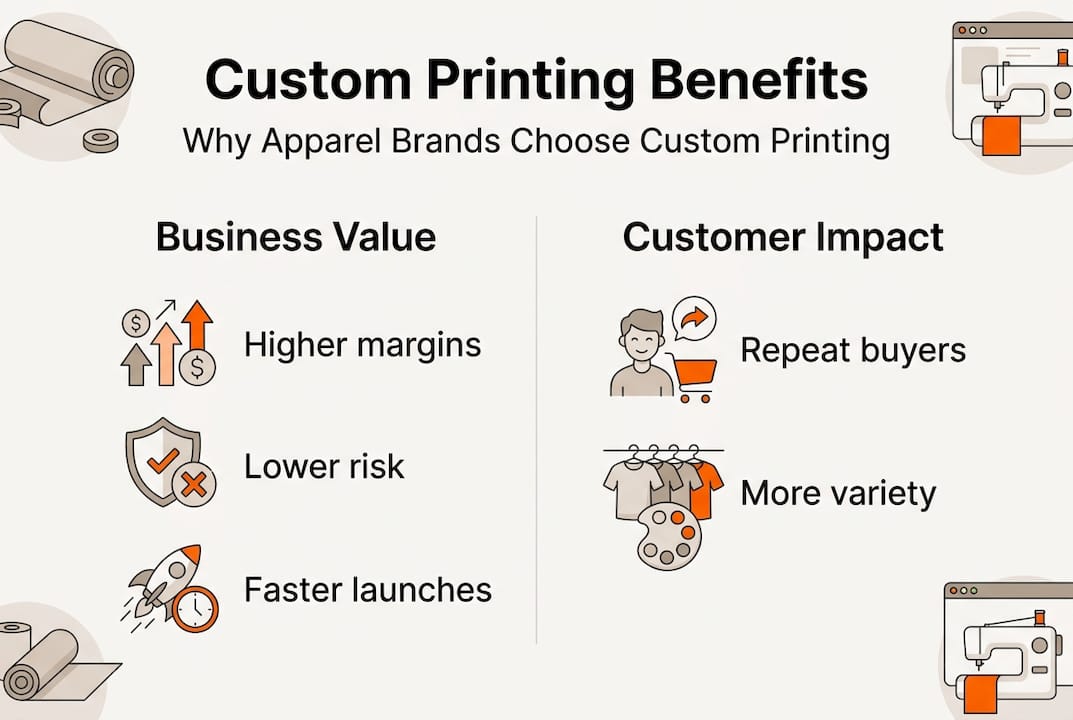
Custom printing is not just about aesthetics. It directly affects your margins, your customer relationships, and your operational risk. Here is a breakdown of the core advantages.
1. Higher profit margins per item Custom designs justify premium pricing. Buyers pay more for something that feels made for them.
2. Stronger customer retention Apparel printing benchmarks show that custom apparel drives up to 20% higher retention rates compared to generic products, with an average order value (AOV) around $55.
3. Lower inventory risk With POD, you print what you sell. No overstock. No markdowns. No wasted product sitting in a storage unit.
4. Faster product launches Small runs mean you can test a design in days, not weeks. If it sells, scale it. If it does not, move on without a loss.
5. Broader product range Custom printing lets you offer seasonal drops, limited editions, and customer-designed pieces without retooling your entire operation.
| Feature | Custom printed apparel | Mass-produced apparel |
|---|---|---|
| Pricing power | High (20% premium) | Low |
| Customer retention | Strong | Moderate |
| Inventory risk | Low (POD model) | High |
| Design flexibility | Full control | Limited |
| Minimum order quantity | Low to none | Often high |
Explore the full breakdown of benefits of DTF printing and why same day printing is becoming a competitive advantage. You can also browse custom apparel success stories to see how other brands are putting these benefits to work.
Pro Tip: Launch a limited edition run of 12 to 24 pieces before committing to a full collection. It tests demand, builds urgency, and keeps your cash flow clean.
DTF printing versus other custom methods: What’s best for you?
Not all printing methods are equal. The right choice depends on your order volume, design complexity, and how fast you need to turn orders around.
| Method | Setup cost | Min. order | Color complexity | Turnaround |
|---|---|---|---|---|
| DTF (Direct-to-Film) | Low | 1 piece | Full color, detailed | Very fast |
| DTG (Direct-to-Garment) | Medium | 1 piece | Full color | Moderate |
| Screen printing | High | 12 to 24+ | Limited colors | Slower |
DTF stands out for small apparel brands because it requires no screens, no setup fees, and no minimum order. The adoption of new technologies in custom apparel is driving lower waste and higher quality across the board, and DTF is leading that shift.
Here is a quick guide on when to use each method:
- DTF: Best for small runs, fast turnarounds, detailed artwork, and mixed garment types
- DTG: Good for one-off prints directly on fabric, especially for soft-hand feel on cotton
- Screen printing: Best for large volume runs with simple, bold designs and consistent colors
Many small brands combine methods. Use DTF for new releases and test runs, then shift to screen printing once a design proves it sells at volume. Learn more about DTF and DTG methods and how to approach cost-effective DIY printing for your setup.
Pro Tip: DTF transfers are ready to press onto almost any fabric type, including cotton, polyester, and blends. That flexibility alone makes it the most versatile option for brands selling across multiple product categories.
How print-on-demand (POD) with DTF streamlines production
POD paired with DTF is one of the most practical setups for small apparel brands. You get speed, flexibility, and low financial risk all in one workflow.
Here is how to implement it:
- Create your design files in the correct format (300 DPI, transparent background, RGB color mode)
- Upload to your DTF provider and order transfers in the quantity you need, even just one
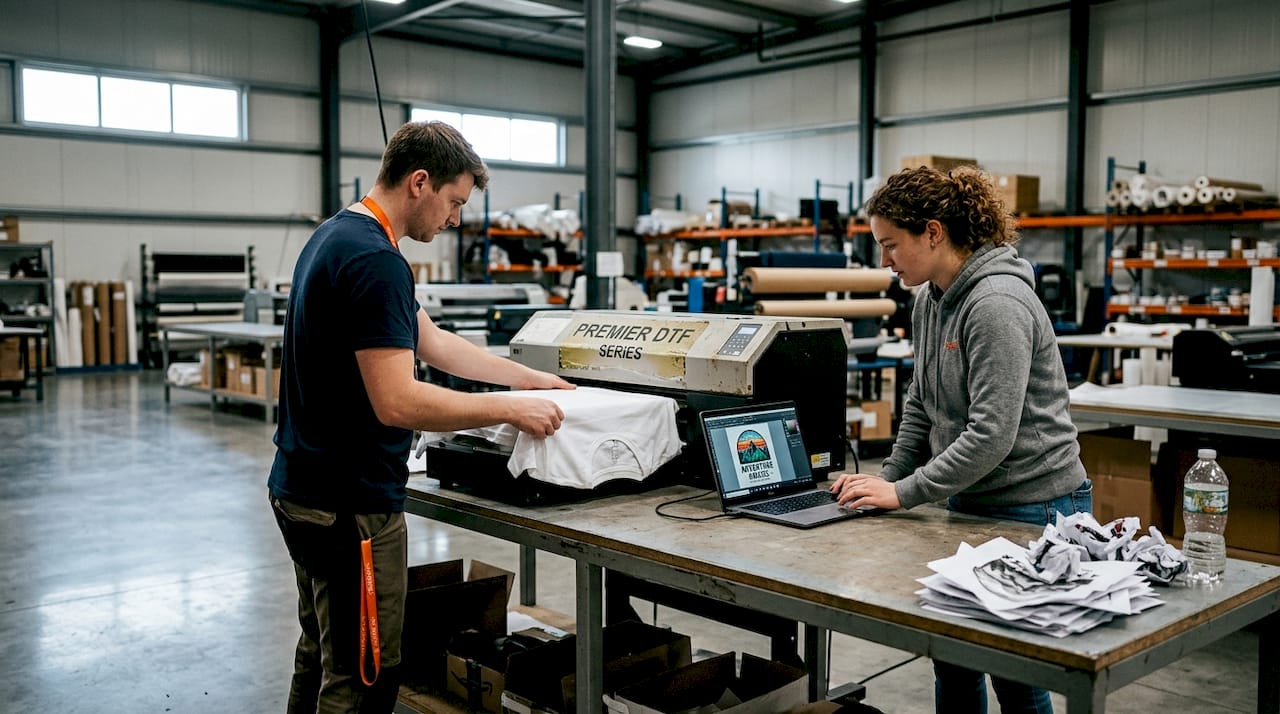
- Receive ready-to-press transfers and heat-press them onto garments as orders come in
- Fulfill and ship directly to your customer without holding pre-printed inventory
- Reorder transfers as needed, scaling up or down based on real demand
“Reduce unsold inventory and risk. Print only what you sell.”
This model is especially powerful for seasonal launches. Instead of guessing how many holiday tees to stock, you print transfers in advance and press garments only when orders arrive. That keeps your cash tied up in transfers, not finished goods sitting on a shelf.
Print-on-demand increases profit margins and reduces unsold inventory for small apparel brands, making it one of the smartest operational moves you can make in 2026. For more on speeding up your workflow, read about boosting efficiency with fast printing and review these design tips for quality before your next launch.
Getting started: Steps to maximize custom printing benefits
Ready to put this into practice? Here is a straightforward path to launching or improving your custom garment printing operation.
- Choose a reliable DTF provider with fast turnaround, transparent pricing, and consistent print quality
- Prepare your artwork at 300 DPI with a transparent background and accurate color profiles
- Order a small test run to verify color accuracy, placement, and wash durability before scaling
- Set up your heat-press at the correct temperature and pressure for your garment type
- Launch your first collection with a limited drop to generate urgency and gather real customer feedback
- Analyze results and scale what works, then retire what does not
Avoid these common mistakes:
- Ordering too much inventory before testing demand
- Skipping quality checks on the first press of a new transfer
- Placing designs without checking garment-specific sizing guides
- Using low-resolution artwork that looks blurry after pressing
- Ignoring wash tests before selling to customers
Consumers pay a 20% premium for personalized products, so the margin is there. Your job is to protect it by keeping quality high and waste low. Starting small is not a limitation. It is a strategy. Read more about why invest in DIY transfers to understand the full financial case for bringing custom printing into your workflow.
Streamline your custom apparel production with expert DTF solutions
You now have a clear picture of how custom garment printing can grow your brand, protect your margins, and simplify your production. The next step is finding a partner who can keep up with your pace.
At DIY Printz, we produce hundreds to thousands of DTF transfer orders every month with consistent quality and fast turnaround. Whether you need a single transfer or a bulk run, our same day DTF transfers are ready to press and built for brands that cannot afford delays. You do not need to own a printer or manage the production process. We handle it all so you can focus on pressing, selling, and growing. Visit DIY Printz to explore all available options and place your first order today.
Frequently asked questions
How much more can I charge for custom-printed apparel?
On average, consumers are willing to pay about 20% more for customized apparel compared to generic alternatives. That premium adds up quickly across even a small product line.
What is the main advantage of DTF over traditional screen printing?
DTF enables faster turnarounds and supports detailed multi-color designs without setup costs for small batches. DTF and POD models also lower operational risks compared to traditional methods.
How does print-on-demand reduce waste for small apparel brands?
Print-on-demand means you only make what sells, so there is no unsold inventory piling up. POD reduces waste and keeps your production costs tied directly to actual revenue.
What should I look for in a reliable custom printing partner?
Prioritize fast turnaround, high print quality, transparent pricing, and responsive customer support. A good partner should also offer flexible order quantities so you can start small and scale without friction.
Recommended
READY TO PRINT?
Send us your artwork and we'll dial in your DTF transfer, color, and same-day turnaround.