

Benefits of DTF printing for apparel business 2026
Discover how DTF printing delivers 70% faster setup, 50+ wash durability, and 35% efficiency gains for apparel businesses in 2026 through quality transfers and smart outsourcing.

Choosing the right printing method for your apparel business can feel overwhelming when you’re balancing print quality, production speed, and operational complexity. DTF printing has emerged as a powerful solution that delivers vibrant, durable prints with fast turnaround times and minimal equipment hassles. This guide explores the key benefits of DTF transfers and shows how they can transform your apparel production workflow in 2026.
Table of Contents
- How To Choose The Right Transfer Printing Method For Your Apparel Business
- Benefit 1: Exceptional Print Quality And Color Vibrancy
- Benefit 2: Cost And Time Efficiency Compared To Screen Printing
- Benefit 3: Durability, Versatile Material Compatibility, And Comfort Of Dtf Transfers
- Benefit 4: Faster Turnaround, Scalability, And Operational Efficiency By Outsourcing Dtf Printing
- Summary Comparison And Recommendations For Different Business Needs
- Explore Same Day Dtf Transfers For Your Apparel Business
- Frequently Asked Questions
Key takeaways
| Point | Details |
|---|---|
| Superior print quality | DTF delivers vibrant, high-resolution prints up to 1440 dpi on multiple fabric types with exceptional color accuracy. |
| Cost and time efficiency | DTF reduces setup time by 70% and costs 20% to 40% less per print compared to screen printing on runs under 500 units. |
| Durability and comfort | DTF transfers maintain quality through 50+ wash cycles while offering a softer, thinner print layer than vinyl alternatives. |
| Scalable outsourcing | Professional DTF services eliminate $10,000 to $20,000 equipment costs while increasing workflow efficiency by up to 35%. |
How to choose the right transfer printing method for your apparel business
Before diving into specific DTF benefits, you need to understand the core criteria that separate good printing methods from great ones. Your choice affects everything from your profit margins to customer satisfaction rates.
Start by evaluating your print quality requirements. Ask yourself whether your designs demand photographic detail, complex gradients, or simple solid colors. High-detail artwork needs different capabilities than basic text or logos.
Next, consider your typical production volume and required turnaround speed. Some methods excel at large runs but fail miserably on small batches. Others offer flexibility but sacrifice speed.
Cost analysis goes beyond just per-unit pricing. Factor in equipment investment, material costs, labor hours, and maintenance expenses. A cheaper per-print method might cost more overall when you include setup time and waste.
Material compatibility matters more than most business owners realize. Your printing method should work seamlessly across cotton, polyester, blends, and specialty fabrics without compromising quality or durability.
Finally, decide whether owning equipment or outsourcing production makes better business sense. This choice impacts your capital requirements, operational complexity, and ability to scale quickly.
Key evaluation criteria include:
- Print resolution and color accuracy requirements
- Typical order sizes and production timelines
- Total cost of ownership versus per-unit pricing
- Range of fabrics and garment types you serve
- Available space, staff expertise, and maintenance capacity
Benefit 1: exceptional print quality and color vibrancy
DTF printing consistently delivers sharp detail up to 1440 dpi with color vibrancy that rivals or exceeds traditional methods. This level of precision means your customers see every gradient, shadow, and fine line exactly as designed.
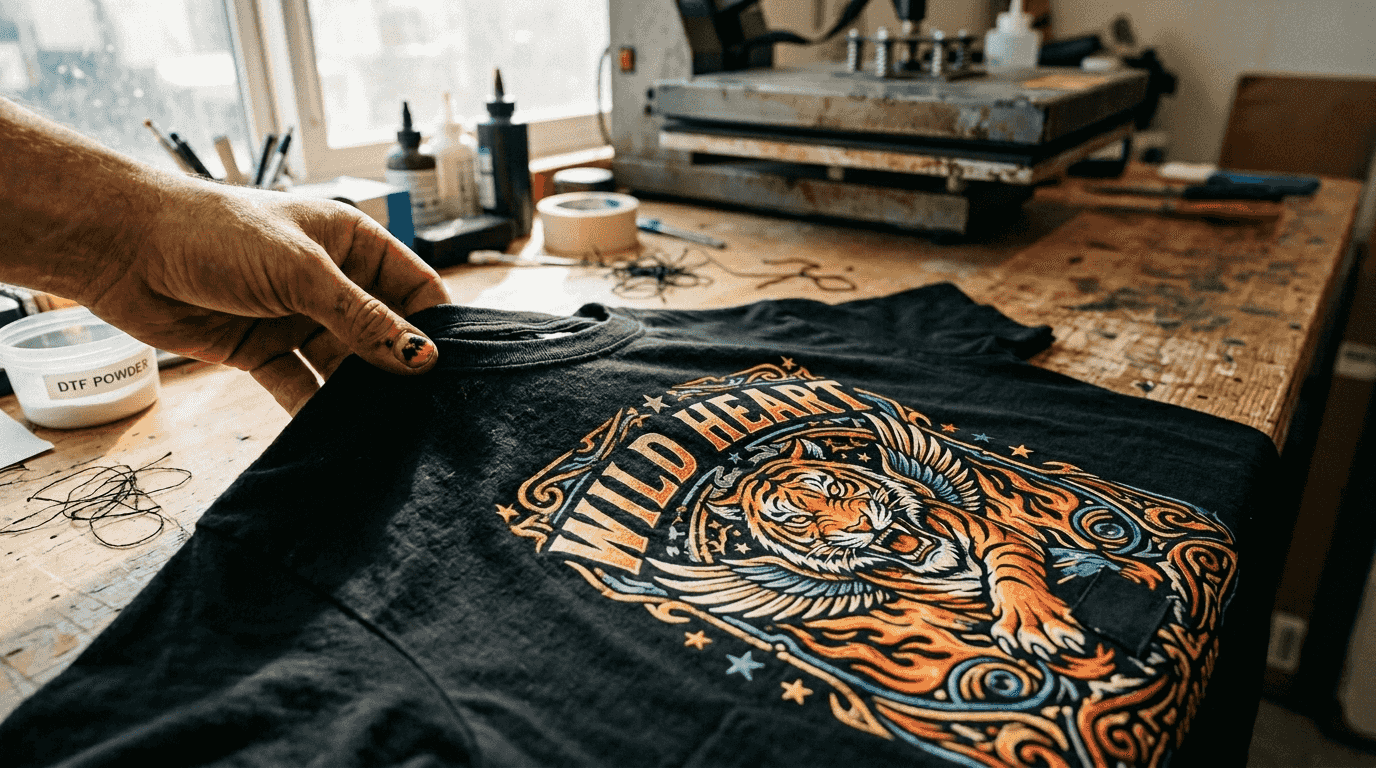
The technology excels at reproducing complex multicolor graphics without the color separation headaches of screen printing. Whether you’re printing photographic images, intricate logos, or detailed artwork, DTF maintains color accuracy across the entire spectrum.
One often overlooked advantage is the soft hand feel of DTF prints. The transfer layer sits thinner on the fabric compared to bulkier alternatives, creating a more premium finish that customers notice immediately. This improved aesthetic quality justifies higher price points and builds brand reputation.
DTF transfers work particularly well for designs requiring fine details like small text, thin lines, or subtle shading. Understanding DTF printing terminology helps you communicate quality expectations clearly with service providers.
Quality advantages include:
- Resolution up to 1440 dpi for photographic clarity
- Full-spectrum color reproduction without dot gain issues
- Thinner print layer for superior garment aesthetics
- Consistent quality across complex multicolor designs
Pro Tip: Request sample prints on your actual fabric types before committing to large production runs to verify color matching and hand feel meet your brand standards.
Benefit 2: cost and time efficiency compared to screen printing
The efficiency gap between DTF and screen printing becomes obvious when you examine setup requirements. Screen printing demands creating physical screens, mixing custom inks, and running test prints before production starts. DTF reduces setup time by 70% because you simply load your digital file and print.
This time savings translates directly into cost advantages on smaller runs. Screen printing achieves lower per-unit costs only at volumes above 500 pieces, where setup costs spread across many items. Below that threshold, DTF typically costs 20% to 40% less per print while delivering comparable or better quality.
The flexibility to print one unit or one thousand without changing your process gives you incredible responsiveness. You can test new designs, fulfill custom orders, and respond to trending topics without the financial risk of creating expensive screens that might never get reused.
Eliminating screen preparation also removes a major source of waste and environmental impact. No emulsion chemicals, no screen reclaiming process, and no wasted ink from color mixing errors.
| Method | Setup Time | Cost Per Unit (100 qty) | Min Order | Color Limit |
|---|---|---|---|---|
| DTF Printing | 15-30 min | $3.50-$5.00 | 1 piece | Unlimited |
| Screen Printing | 2-4 hours | $5.00-$8.00 | 50+ pieces | 1-6 colors |
| DTG Printing | 10-20 min | $4.00-$6.50 | 1 piece | Unlimited |
| Vinyl Transfer | 20-40 min | $4.50-$7.00 | 1 piece | Limited |
Operational benefits include:
- No screen creation, storage, or reclaiming costs
- Digital files enable instant design changes
- Zero color separation or registration alignment issues
- Immediate production start for rush orders
Exploring a detailed DTF vs screen printing comparison reveals additional workflow and quality differences that impact your bottom line.
Pro Tip: Calculate your true break-even point by including labor hours for screen prep, cleaning, and storage costs that often get overlooked in simple per-unit comparisons.
Benefit 3: durability, versatile material compatibility, and comfort of DTF transfers
Durability concerns stop many business owners from trying new printing methods, but DTF transfers prove their resilience through real-world testing. These prints maintain quality through 50+ wash cycles with proper care, showing minimal fading or cracking even on frequently worn garments.
The molecular bonding between DTF adhesive powder and fabric fibers creates a permanent bond that resists peeling at edges and corners where other methods often fail. This reliability matters enormously for businesses selling performance wear, uniforms, or everyday apparel that faces repeated washing.
Material versatility sets DTF apart from competing technologies. The same transfer process works beautifully on 100% cotton, polyester, cotton-poly blends, nylon, and even specialty fabrics like spandex or moisture-wicking materials. You can maintain consistent quality across your entire product line without switching methods.
The comfort factor deserves special attention because it directly impacts customer satisfaction and repeat purchases. DTF print layers measure approximately 50% thinner than traditional vinyl transfers, creating a softer hand feel that breathes better and moves naturally with the fabric.
This reduced thickness becomes particularly important for athletic wear, children’s clothing, or any application where comfort drives buying decisions. Customers notice the difference immediately when comparing DTF printed garments to bulkier alternatives.
Durability and compatibility advantages:
- Wash durability exceeding 50 cycles with proper care
- Resistance to cracking, peeling, and edge lifting
- Compatible with cotton, polyester, blends, nylon, and specialty fabrics
- Print layer up to 50% thinner than vinyl for superior comfort
- Maintains flexibility and stretch on performance fabrics
Following a comprehensive DTF print durability guide ensures your transfers last as long as the garments themselves.
Benefit 4: faster turnaround, scalability, and operational efficiency by outsourcing DTF printing
Production speed separates thriving apparel businesses from struggling ones in 2026’s competitive marketplace. DTF printing enables turnaround times as fast as 24 to 48 hours for small batch orders, letting you respond to trending designs or rush customer requests that other methods simply cannot accommodate.
The real magic happens when you examine scalability. The same DTF process that produces a single custom transfer scales seamlessly to 10,000+ units without quality degradation or exponential cost increases. This flexibility means you never turn away orders because they’re too small or too large for your capabilities.
Outsourcing DTF printing transforms these benefits into pure business advantage. Professional DTF services eliminate $10,000 to $20,000 equipment costs while removing the maintenance headaches, supply chain management, and technical expertise requirements of owning your own printer.
The efficiency gains go beyond just equipment savings. Outsourcing partners handle file preparation, quality control, and production scheduling, freeing your team to focus on design, sales, and customer service where you add the most value. Studies show this approach can increase overall workflow efficiency by up to 35%.
You also avoid the learning curve associated with mastering DTF printing variables like powder application, curing temperatures, and film tensioning. These technical details matter enormously for print quality but require months of experience to optimize.
Scalability and efficiency benefits:
- Turnaround as fast as 24 to 48 hours on small orders
- Seamless scaling from 1 to 10,000+ units with consistent quality
- Zero capital investment in $10,000 to $20,000 printing equipment
- No maintenance, consumables management, or technical training required
- Up to 35% workflow efficiency improvement by focusing on core business activities
Pro Tip: Choose outsourcing partners who offer automated tools like gang sheet builders that let you upload multiple designs at once, further streamlining your ordering process and reducing manual work.
Discovering how DTF transfers boost efficiency helps you quantify the real return on investment from professional services.
Summary comparison and recommendations for different business needs
Understanding how DTF stacks up against competing methods helps you make confident decisions aligned with your specific business model and customer base.
DTF printing offers the best balance of print quality, material versatility, and cost efficiency for small to medium production runs. It excels when you need design flexibility, fast turnaround, or compatibility across multiple fabric types.
Screen printing still dominates very large runs of simple designs where setup costs spread across thousands of identical items. However, the break-even point keeps rising as DTF technology improves and costs decrease.
Direct-to-garment printing suits high-detail photographic work directly on cotton garments but struggles with polyester and suffers from slower production speeds and higher per-unit costs. Material limitations make it less versatile than DTF for diverse product catalogs.
Vinyl transfers work well for simple, bold designs needing extreme durability but sacrifice comfort due to thick, rubbery layers. They also require more manual labor for weeding and application compared to DTF’s streamlined process.
| Method | Best For | Quality | Cost Efficiency | Material Range | Comfort |
|---|---|---|---|---|---|
| DTF Printing | Small-medium runs, complex designs | Excellent | High | Very Wide | Excellent |
| Screen Printing | Large runs, simple designs | Excellent | Medium-High | Medium | Good |
| DTG Printing | Cotton garments, photo prints | Excellent | Low-Medium | Narrow | Excellent |
| Vinyl Transfer | Simple graphics, extreme durability | Good | Medium | Medium | Fair |
Business recommendations by scenario:
- Startups and small brands: Outsource DTF for maximum flexibility and minimal investment
- Growing businesses with consistent volume: Consider hybrid approach using outsourced DTF for variety and owned equipment for high-volume staples
- Established operations: Evaluate total production mix to determine optimal balance of in-house and outsourced capabilities
- Custom and on-demand sellers: DTF outsourcing provides unmatched responsiveness without inventory risk
Learning proper DTF transfer maintenance techniques helps you educate customers on care instructions that maximize print longevity.
Explore same day DTF transfers for your apparel business
Now that you understand DTF printing’s powerful advantages for quality, efficiency, and scalability, consider how professional transfer services can transform your production workflow. Same day DTF transfers eliminate equipment costs and technical complexity while delivering the speed and quality your business demands.
Professional DTF services handle everything from file preparation to quality control, letting you focus on design, marketing, and customer relationships. Automated tools like gang sheet builders streamline ordering, while experienced production teams ensure consistent results across every order size. Exploring how DTF printing enhances apparel production reveals additional workflow improvements that compound over time to significantly boost profitability and customer satisfaction.
Frequently asked questions
What is DTF printing and how does it work?
DTF printing creates transfers by printing designs onto special film using water-based inks, applying hot-melt adhesive powder, then curing the transfer before application to garments with a heat press. This process bonds the ink permanently to fabrics, creating durable, vibrant prints. The technology works across cotton, polyester, blends, and specialty materials without pre-treatment requirements.
How does DTF printing compare to screen printing for small businesses?
DTF printing offers 70% faster setup, 20% to 40% lower costs on runs under 500 units, and unlimited color capability compared to screen printing’s lengthy preparation and color limitations. Small businesses benefit from DTF’s flexibility to print single items or hundreds without minimum order requirements or expensive screen creation. The digital workflow also enables rapid design changes and same-day production impossible with traditional screen methods.
Can DTF transfers withstand commercial washing and daily wear?
DTF transfers maintain print quality through 50+ wash cycles when properly cured and cared for, showing excellent resistance to fading, cracking, and peeling. The adhesive creates molecular bonding with fabric fibers that withstands commercial laundering better than many vinyl alternatives. Proper heat press settings and customer care instructions ensure maximum durability for daily wear applications.
What are the main benefits of outsourcing DTF printing versus owning equipment?
Outsourcing eliminates $10,000 to $20,000 equipment investment while removing maintenance costs, supply management, and technical training requirements. Professional services deliver consistent quality, faster turnaround on rush orders, and seamless scalability from single prints to thousands. This approach increases workflow efficiency by up to 35% by letting you focus resources on design, sales, and customer service rather than production operations.
Which fabrics and garment types work best with DTF transfers?
DTF transfers work excellently on cotton, polyester, cotton-poly blends, nylon, spandex, and moisture-wicking performance fabrics without quality degradation. This versatility lets businesses maintain consistent branding across t-shirts, hoodies, athletic wear, bags, and accessories using a single printing method. The thin transfer layer also preserves fabric stretch and breathability better than thicker vinyl alternatives, making DTF ideal for activewear and fitted garments.
Recommended
READY TO PRINT?
Send us your artwork and we'll dial in your DTF transfer, color, and same-day turnaround.


