

DTF transfer durability guide for lasting prints
Master DTF transfer durability with proven techniques for materials, application, fabric compatibility, and care protocols that ensure lasting, vibrant prints for your apparel business.

You’ve invested time and money into creating custom apparel, only to see prints crack, fade, or peel after a few washes. Many business owners believe DTF transfer durability issues stem from inferior materials, but the reality is different. Most longevity problems trace back to inconsistent application techniques, fabric mismatches, and improper care protocols. Understanding these controllable factors empowers you to produce prints that withstand commercial washing cycles and maintain vibrant colors for years.
Table of Contents
- Introduction To DTF Transfer Durability
- Materials That Determine Durability: Films, Inks, And Adhesives
- The Application Process: Heat Pressing And Curing Best Practices
- Fabric Compatibility And Its Impact On DTF Transfer Lifespan
- Durability Metrics And Industry Benchmarks
- Common Causes And Misconceptions About DTF Transfer Durability
- Care And Washing Protocols To Maximize Transfer Longevity
- Conclusion: How To Achieve Reliable, Durable DTF Transfers For Your Business
- Enhance Your Apparel Business With Professional DTF Transfers
Key takeaways
| Point | Details |
|---|---|
| Material quality matters | High-pigment inks, quality TPU powder, and advanced films create the foundation for long-lasting transfers. |
| Application precision is critical | Proper temperature, pressure, dwell time, and pre-pressing eliminate moisture and maximize adhesive bonding. |
| Fabric compatibility affects lifespan | Natural fibers typically offer better adhesion than synthetics, which may require specialized films. |
| Durability rivals screen printing | Correctly applied DTF transfers can endure 50 to 60 commercial washes with minimal degradation. |
| Care protocols extend print life | Inside-out washing, cold water, no fabric softener, and low heat drying preserve transfer integrity. |
Introduction to DTF transfer durability
DTF transfer durability encompasses three critical performance metrics: wash cycle resistance, fade resistance, and crack resistance. For apparel businesses, these factors directly impact customer satisfaction, return rates, and brand reputation. When a customer’s favorite shirt maintains vibrant colors and intact graphics after dozens of washes, they become repeat buyers and brand advocates.
Compared to traditional methods, DTF transfers hold their own remarkably well. A properly applied, high-quality DTF transfer can endure up to 60 commercial washes, equaling years of wear without fading or cracking, rivaling traditional screen printing. This performance level surprises many who assume newer technology can’t match established methods.
Industry benchmarks typically measure durability in commercial wash cycles because home washing varies widely. A commercial wash cycle uses hotter water, stronger detergents, and more aggressive agitation than typical home machines. If a transfer survives 50 commercial cycles, it will likely last years in normal home care.
Common misconceptions plague DTF durability discussions. Some believe all DTF transfers fade quickly or that the technology inherently limits longevity. These beliefs stem from poor-quality materials or improper application rather than inherent DTF limitations. Understanding the types of DTF transfers available helps you select options suited to your durability requirements.
Key durability factors include:
- Material quality: ink pigment concentration, adhesive powder composition, film flexibility
- Application technique: heat press settings, pre-pressing protocols, peel timing
- Fabric selection: fiber content, weave density, surface texture
- Post-application care: washing temperature, detergent type, drying method
Materials that determine durability: films, inks, and adhesives
The consumables you choose create the durability foundation. High-pigment inks resist fading because concentrated colorants withstand repeated washing and UV exposure better than diluted formulations. When evaluating ink quality, look for manufacturers who specify pigment load percentages and lightfastness ratings.
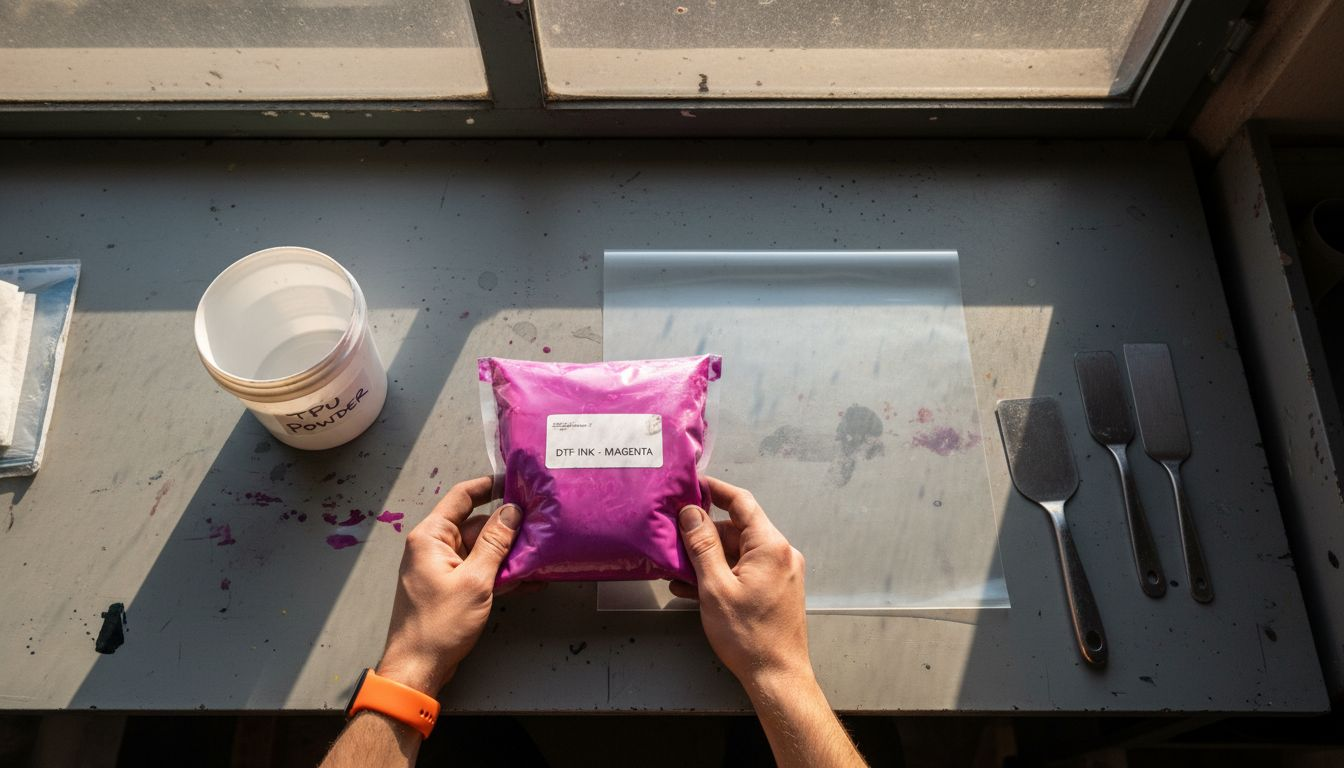
TPU (thermoplastic polyurethane) powder quality dramatically affects adhesion strength and flexibility. Premium adhesive powders melt uniformly at lower temperatures, creating stronger bonds without compromising the transfer’s ability to stretch with fabric. Cheap powders often contain filler materials that reduce adhesion or create stiff, uncomfortable prints prone to cracking.
Advances in film and adhesive chemistries improve adhesion and durability significantly since 2025. Modern films incorporate plasticizers that maintain flexibility through temperature extremes and repeated washing cycles. These chemical improvements mean today’s DTF transfers outperform older generations by measurable margins.
The interaction between materials during curing determines final durability. When you apply heat and pressure, the adhesive powder melts and penetrates both the film and fabric fibers. Quality materials create a molecular bond that resists separation even under stress. Understanding DTF printing fundamentals helps you appreciate how these components work together.
Pro Tip: Source your films, inks, and adhesive powders from established suppliers who provide technical data sheets and batch consistency guarantees. Switching suppliers mid-production can introduce quality variations that affect durability, even if you maintain identical pressing parameters.
Material considerations include:
- Ink formulation: pigment concentration, binder quality, colorant stability
- Adhesive powder: particle size uniformity, melting point consistency, bond strength
- Film substrate: thickness, stretch recovery, heat resistance
- Storage conditions: temperature control, humidity management, shelf life adherence
A comprehensive DTF printing checklist ensures you maintain material quality standards throughout production. When durability issues arise, consult a DTF troubleshooting guide to identify whether materials or process caused the problem. Learning what are DTF transfers at a fundamental level helps you make informed purchasing decisions.
The application process: heat pressing and curing best practices
Perfect materials mean nothing without proper application. A well-pressed DTF transfer with precise temperature, time, and pressure settings combined with pre-pressing to eliminate moisture leads to optimal adhesive bonding and maximizes durability and wash resistance. Your heat press becomes the critical tool determining whether materials reach their durability potential.
Temperature accuracy matters more than most realize. A variance of just 10 degrees Fahrenheit can mean the difference between perfect adhesion and premature failure. Invest in a quality heat press with accurate digital temperature control and calibrate it regularly with an infrared thermometer.
Critical pressing parameters work together as a system. Temperature activates the adhesive, pressure forces penetration into fabric fibers, and dwell time allows complete melting and bonding. Missing any element compromises durability regardless of material quality.
Pre-pressing eliminates moisture trapped in fabric fibers. Even new garments contain humidity that converts to steam under heat press pressure, creating a barrier between adhesive and fabric. This steam prevents molecular bonding and creates weak spots prone to peeling.
Follow this proven pressing protocol:
- Pre-press the garment for 5 to 7 seconds at full pressure to remove moisture and wrinkles
- Position the DTF transfer with the printed side facing up on the garment
- Apply heat at manufacturer-recommended temperature (typically 300 to 320°F) for 15 to 20 seconds
- Maintain firm, even pressure across the entire transfer surface
- Allow the transfer to cool for 10 to 15 seconds before peeling (hot peel or cold peel per manufacturer specs)
- Apply a protective sheet and press again for 5 seconds to seal edges
Common pressing mistakes that destroy durability include insufficient pressure (air pockets prevent adhesion), inconsistent dwell time (rushed pressing leaves weak bonds), and skipping pre-press steps (moisture blocks proper melting). Using a detailed DTF printing checklist prevents these errors.
Pro Tip: Conduct test presses on sample garments before production runs. Press identical transfers at slightly different temperatures and dwell times, then wash test them. This simple quality control step identifies optimal settings for your specific equipment, materials, and fabric combinations.
When problems occur, a comprehensive DTF troubleshooting guide helps diagnose whether application technique or materials caused the issue. Many durability failures blamed on poor materials actually stem from inconsistent pressing protocols.
Fabric compatibility and its impact on DTF transfer lifespan
Fabric choice influences transfer adhesion as much as materials and application technique. Natural fibers like 100% cotton provide excellent adhesion because their porous structure allows adhesive penetration. The rougher surface texture creates mechanical bonding points that resist peeling even after aggressive washing.
Synthetic fabrics present unique challenges. Polyester’s smooth, dense surface resists adhesive penetration, potentially creating weaker bonds. Some polyester blends require specialized adhesive powders formulated for synthetic fiber adhesion. Tri-blends (cotton/polyester/rayon) offer moderate adhesion but may need adjusted pressing parameters.
Fabric testing prevents costly mistakes. Before committing to large production runs, press test transfers on sample garments and put them through 10 to 15 wash cycles. Monitor for peeling, cracking, fading, or adhesion failures. This investment saves money compared to customer returns from incompatible fabric choices.
Top fabric compatibility notes:
- 100% cotton: excellent adhesion, high durability, natural texture supports bonding
- Cotton/polyester blends: good adhesion with proper temperature adjustment
- 100% polyester: requires synthetic-compatible adhesives, lower press temperature
- Tri-blends: moderate adhesion, test pressing essential for optimal parameters
- Performance fabrics: specialized films needed, moisture-wicking properties affect adhesion
| Fabric Type | Adhesion Strength | Typical Durability | Special Considerations |
|---|---|---|---|
| 100% Cotton | Excellent | 50-60+ washes | Standard adhesive works well |
| 50/50 Cotton/Poly | Very Good | 45-55 washes | May need temperature adjustment |
| 100% Polyester | Good | 40-50 washes | Requires synthetic adhesive powder |
| Tri-Blend | Good | 40-50 washes | Test pressing recommended |
| Performance/Athletic | Variable | 35-45 washes | Specialized films often required |
Understanding DTF transfer maintenance protocols helps you educate customers on fabric-specific care. Different fabrics respond differently to washing temperatures and drying methods. A streamlined DTF transfer workflow includes fabric compatibility testing as a standard quality control checkpoint.
Durability metrics and industry benchmarks
Quantifying durability requires standardized metrics. The industry measures performance in commercial wash cycles, aesthetic retention percentage, and physical integrity scores. These objective measurements allow meaningful comparisons between DTF transfers, screen printing, and vinyl heat transfers.
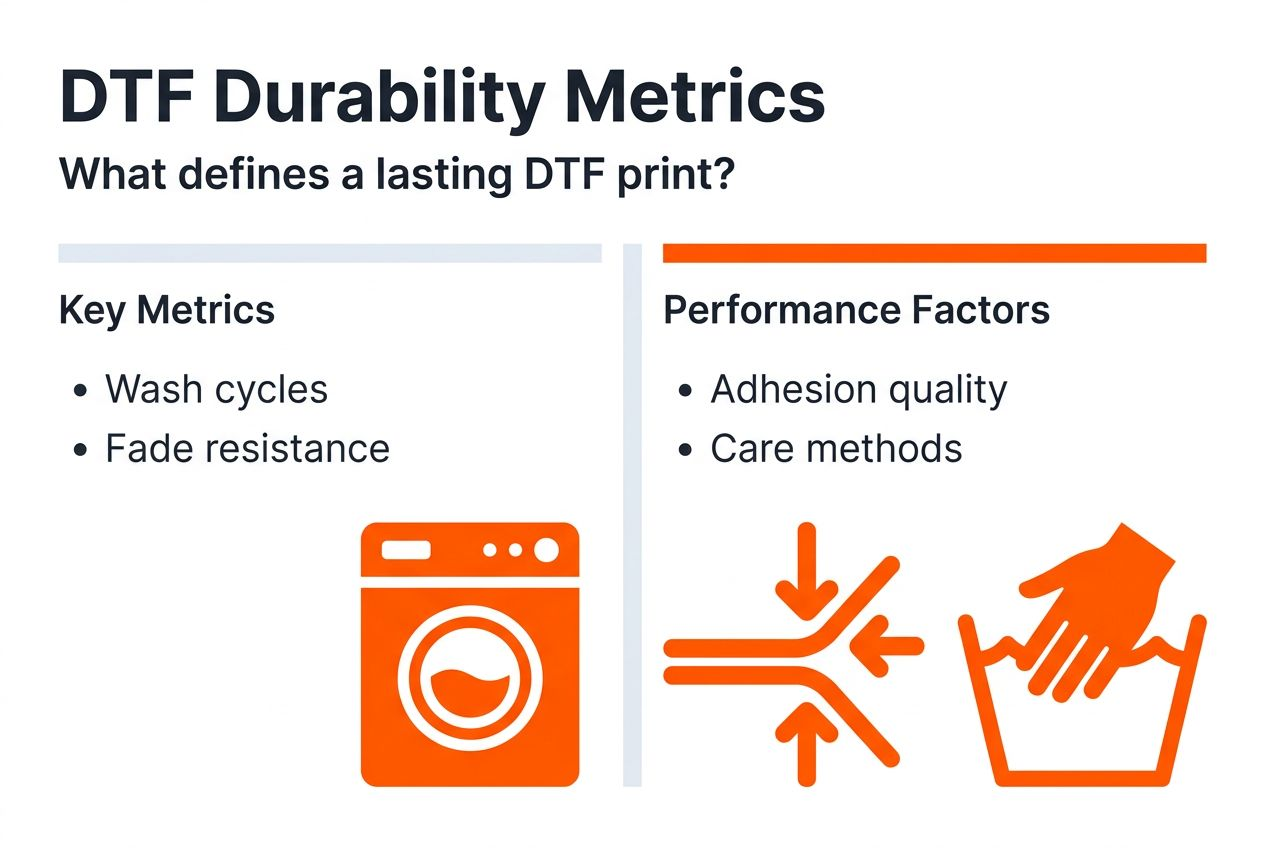
A commercial wash cycle simulates aggressive home washing. Test labs use 140°F water, commercial-grade detergent, and extended agitation cycles. If a transfer survives 50 commercial cycles, it typically endures 100 to 150 home wash cycles. This conservative testing ensures products meet real-world durability expectations.
Aesthetic retention measures color vibrancy and graphic sharpness over time. A transfer maintaining 90% of original color intensity after 40 washes demonstrates excellent fade resistance. Physical integrity tracks cracking, peeling, and adhesion failures. Premium transfers show zero cracking and less than 5% edge lifting after benchmark wash counts.
| Print Method | Typical Wash Cycles | Fade Resistance | Crack Resistance | Application Complexity |
|---|---|---|---|---|
| Quality DTF | 50-60 cycles | Excellent (90%+ retention) | Excellent (minimal cracking) | Moderate (requires proper pressing) |
| Screen Print | 50-70 cycles | Excellent (95%+ retention) | Very Good (occasional cracking) | High (setup intensive) |
| Vinyl Heat Transfer | 30-40 cycles | Good (80-85% retention) | Moderate (prone to cracking) | Low (simple application) |
| Direct-to-Garment | 40-50 cycles | Very Good (85-90% retention) | Excellent (no cracking) | Moderate (requires pretreatment) |
These benchmarks guide your production standards. When customers ask about durability, you can confidently cite wash cycle data backed by industry testing. Understanding how DTF vs screen printing durability compares helps you position your products accurately. Exploring hybrid DTF techniques may further enhance durability for specialized applications.
Common causes and misconceptions about DTF transfer durability
Many business owners assume durability failures always indicate inferior materials. This misconception leads to unnecessary supplier changes and continued problems. In reality, 70% of durability issues stem from application errors, fabric incompatibility, or improper care instructions rather than material defects.
Inconsistent pressing ranks as the top durability killer. When operators rush through pressing or apply uneven pressure, transfers develop weak spots that fail prematurely. Temperature variations across the heat platen create zones of incomplete adhesion. These process errors create seemingly random failures that frustrate troubleshooting efforts.
Another myth suggests all DTF films and adhesives perform identically across fabric types. Cotton-optimized adhesives may fail on polyester because molecular bonding differs between natural and synthetic fibers. Using the same materials and parameters for all fabrics guarantees inconsistent results.
Common failure points and solutions:
- Inadequate pre-pressing: Solution is always pre-press for minimum 5 seconds to eliminate moisture
- Insufficient pressure: Solution is calibrate press regularly and verify even platen contact
- Wrong temperature for fabric: Solution is conduct test presses and adjust per fabric type
- Skipping cool-down period: Solution is allow proper cooling before peeling to prevent adhesive disruption
- Using cotton settings on synthetics: Solution is adjust temperature down 20 to 30°F for polyester
- Customer washing in hot water: Solution is provide clear care labels with every garment
Separating material quality issues from process mistakes requires systematic testing. When durability problems occur, first verify your pressing parameters, fabric compatibility, and care instructions. Only after eliminating these variables should you question material quality. This methodical approach identifies root causes faster and prevents costly material changes that don’t solve the actual problem.
Care and washing protocols to maximize transfer longevity
Post-application care determines whether your perfect pressing job delivers the promised durability. Educating customers on proper garment care protects your brand reputation and reduces return rates. Simple washing protocol changes can double transfer lifespan compared to typical home laundry practices.
Hot water accelerates dye migration and adhesive breakdown. Commercial detergents contain harsh enzymes and brighteners that attack transfer materials. Fabric softeners deposit waxy residues that weaken adhesion over time. High heat drying causes repeated thermal stress that fatigues adhesive bonds and promotes cracking.
Follow this care protocol for maximum longevity:
- Turn garments inside-out before washing to minimize direct agitation on transfers
- Wash in cold or warm water (maximum 86°F) using standard laundry detergent
- Avoid fabric softeners, bleach, and harsh stain removers on printed areas
- Select gentle or normal wash cycle rather than heavy-duty settings
- Remove promptly after washing to prevent color transfer from other garments
- Tumble dry on low heat or hang dry for best results
- Never iron directly on transfers; if needed, iron inside-out with protective cloth
Pro Tip: Create professional care labels or hang tags with washing instructions for every garment you sell. This simple addition educates customers, prevents damage from improper care, and demonstrates your commitment to quality. Include your brand contact information so customers reach out with questions rather than leaving negative reviews.
Care practices impact long-term durability more than most realize. A transfer that could survive 60 commercial washes may fail after 20 cycles if customers consistently use hot water and high heat drying. Conversely, meticulous care can extend lifespan beyond benchmark expectations. Your care instructions become part of your product’s value proposition.
Conclusion: How to achieve reliable, durable DTF transfers for your business
DTF transfer durability results from an integrated system combining material selection, precise application, fabric compatibility, and proper care. No single factor guarantees longevity; instead, attention to every detail creates the synergy needed for prints that withstand years of wear and washing.
Quality materials provide the foundation, but even premium films and inks fail without correct pressing parameters. Perfect application means nothing if fabric choice creates incompatibility or customers wash garments improperly. This interconnected reality requires systematic attention rather than hoping one element compensates for weaknesses elsewhere.
The business benefits of reliable durability extend beyond customer satisfaction. Consistent quality reduces return rates, builds brand reputation, and justifies premium pricing. Customers gladly pay more when they trust products will perform as promised.
Partnering with expert DTF transfer providers eliminates many durability challenges. Professional services maintain material quality, calibrate equipment precisely, and conduct ongoing testing to ensure consistent results. This expertise proves especially valuable when scaling production or entering new fabric categories.
Adopt these best practices immediately: invest in quality materials from verified suppliers, establish standardized pressing protocols with regular equipment calibration, conduct fabric compatibility testing before production runs, and create comprehensive care instructions for customers. Continuous testing and refinement separate amateur operations from professional apparel businesses delivering exceptional durability.
Enhance your apparel business with professional DTF transfers
Achieving consistent DTF transfer durability requires expertise, quality control, and production capacity that many businesses struggle to maintain in-house. Outsourcing to professional DTF transfer printing services eliminates equipment costs, material sourcing challenges, and the learning curve associated with perfecting application techniques.
DIY Printz delivers ready-to-press transfers with guaranteed durability, producing hundreds to thousands of orders monthly with consistent quality and fast turnaround. Our same day DTF transfers service ensures you never miss deadlines, while our auto gang sheet builder streamlines high-volume orders. Focus on growing your brand while we handle the technical challenges of producing durable, professional-quality transfers.
FAQ
What factors most affect DTF transfer durability?
Material quality, proper heat press application, fabric compatibility, and post-application care all significantly affect transfer durability. Each factor must be optimized because weaknesses in any area compromise overall longevity. Systematic attention to all four elements ensures prints withstand 50 to 60 commercial wash cycles with minimal degradation.
How many washes can I expect from a quality DTF transfer?
High-quality DTF transfers properly applied to compatible fabrics typically withstand 50 to 60 commercial wash cycles with minimal fading or cracking. This equals years of normal home washing under proper care conditions. Transfers washed in cold water, dried on low heat, and never exposed to fabric softeners often exceed these benchmarks.
Can I use the same DTF transfer materials on all fabric types?
No, synthetic blends often require specialized films and adhesives to ensure strong adhesion and durability compared to natural fabrics. Cotton-optimized materials may fail on polyester because molecular bonding differs between fiber types. Always conduct test pressing and wash testing when working with new fabric compositions to verify compatibility and adjust parameters.
What are the best washing practices to extend DTF print life?
Wash garments inside-out in cold or warm water, avoid fabric softeners and bleach, and use low heat drying to maximize print longevity. Remove garments promptly after washing and never iron directly on transfers. These simple care protocols can double transfer lifespan compared to aggressive washing with hot water and high heat drying.
Recommended
READY TO PRINT?
Send us your artwork and we'll dial in your DTF transfer, color, and same-day turnaround.


