

What Are DTF Transfers? 40% Efficiency Boost for Businesses
Learn what DTF transfers are and how outsourcing boosts production efficiency by 40% without printer ownership costs, maintenance, or technical complexity.

Outsourcing DTF transfers can boost your production workflow efficiency by up to 40%, yet many business owners believe they must own a DTF printer to succeed. This guide explains what DTF transfers are, how the technology works, and why outsourcing often delivers better results than managing your own equipment. You’ll discover how DTF compares to other printing methods and learn practical strategies to improve your apparel production without the cost and maintenance burden of printer ownership.
Table of Contents
- What Are DTF Transfers and How Do They Work?
- Comparison: DTF Transfers vs. Other Printing Methods
- Why Choose Outsourced DTF Transfers Instead of Owning a Printer?
- Common Misconceptions About DTF Transfers
- How DTF Transfers Boost Business Production Efficiency
- Quality and Durability of DTF Transfers
- Explore Reliable Outsourced DTF Transfer Solutions
- Frequently Asked Questions About DTF Transfers
Key Takeaways
| Point | Details |
|---|---|
| DTF Technology | Direct-to-film transfers print vibrant designs on PET film, then heat press onto cotton, polyester, blends, and nylon. |
| Outsourcing Benefits | Eliminates $15,000+ upfront printer costs and ongoing 30% maintenance expenses while improving workflow efficiency. |
| Comparison Advantage | DTF offers faster turnaround and multi-color cost-effectiveness over DTG and screen printing for small to medium runs. |
| Durability Evidence | Quality DTF transfers withstand 50+ washes with proper application, meeting or exceeding traditional printing methods. |
| Production Impact | Outsourced DTF services remove downtime from printer failures and enable scalable production capacity. |
What Are DTF Transfers and How Do They Work?
DTF transfers represent a modern apparel printing technology that separates design production from garment pressing. DTF printing involves printing designs on PET film with special inks, applying adhesive powder, heat curing, and then pressing onto fabric. This separation creates operational flexibility that traditional direct-to-garment printing cannot match.
The DTF process follows a specific sequence that ensures consistent results. Understanding these steps helps you evaluate whether to invest in equipment or outsource production.
- Design Creation: You prepare artwork files in standard formats like PNG or AI with transparent backgrounds.
- Film Printing: Specialized DTF printers apply CMYK plus white ink layers directly onto clear PET film.
- Powder Application: Hot-melt adhesive powder covers the wet ink immediately after printing.
- Heat Curing: The printed film passes through a heat tunnel or oven to melt and bind the adhesive powder.
- Transfer Pressing: You position the cured film on fabric and apply heat and pressure, bonding the design permanently.
- Film Removal: After cooling, you peel away the PET film, leaving only the transferred design on the garment.
This method works across cotton, polyester, blends, and nylon, making it versatile for diverse product lines. The key advantage lies in producing transfers separately from pressing, which means you can batch create hundreds of designs and press them on demand as orders arrive.
DTF printing basics enable businesses to maintain inventory of ready-to-press transfers rather than finished garments. You reduce waste and respond faster to custom orders without maintaining printer uptime.
Comparison: DTF Transfers vs. Other Printing Methods
Placing DTF transfers in context against established techniques reveals distinct operational and quality advantages. Each method serves specific production scenarios, but DTF eliminates common bottlenecks.
DTF offers higher color vibrancy on dark garments and broader fabric compatibility than DTG. Direct-to-garment printing requires fabric pretreatment and works best on cotton, while screen printing demands higher minimum order quantities to justify setup costs.
| Method | Setup Cost | Fabric Types | Color Vibrancy | Best For |
|---|---|---|---|---|
| DTF | Low (outsource) or $15k-30k (own) | Cotton, polyester, blends, nylon | Excellent on all colors | Small to medium runs, multi-color designs |
| DTG | $10k-25k | Mostly cotton | Good on light fabrics | Single-piece customization, photo-quality prints |
| Screen Printing | $5k-15k | Cotton, some blends | Excellent | High-volume runs (100+ units), limited colors |
Key advantages of DTF transfers include:
- No garment pretreatment required, saving time and chemical costs
- Faster turnaround for orders between 10 and 500 units compared to screen printing setup
- Multi-color designs cost the same per transfer as single-color designs
- Transfers remain shelf-stable for months, enabling inventory management
- Compatible with heat presses you likely already own for other decoration methods
Durability benchmarks show DTF transfers withstand 50+ wash cycles when properly applied, matching screen printing longevity. DTG prints on cotton typically last 40 to 50 washes before noticeable fading. This makes DTF suitable for commercial apparel that customers expect to last.
The comparison table of DTF, DTG, and screen printing demonstrates that DTF fills the gap between low-volume DTG customization and high-volume screen printing efficiency. Following the application guide for DTF transfers ensures you achieve maximum durability regardless of which printing method you choose.
Why Choose Outsourced DTF Transfers Instead of Owning a Printer?
Owning a DTF printer carries substantial hidden costs beyond the initial purchase price. Evaluating the total cost of ownership reveals why outsourcing often delivers better financial results.
Printer ownership costs break down into upfront and ongoing expenses. Entry-level DTF printers start at $15,000, while commercial-grade systems reach $30,000 or higher. These systems require dedicated workspace with proper ventilation and climate control.
Ongoing expenses consume approximately 30% of the initial investment annually:
- Ink refills every few weeks at $400 to $800 per set
- PET film rolls at $150 to $300 per roll
- Adhesive powder at $80 to $150 per container
- Printhead replacements every 6 to 12 months at $500 to $2,000 each
- Maintenance kits and cleaning supplies
- Downtime costs when equipment malfunctions
Maintenance demands technical skills most apparel businesses lack. You need to manage printhead cleaning cycles, calibrate color profiles, troubleshoot clogged nozzles, and diagnose mechanical failures. Each problem costs production time even if you resolve it yourself.
Outsourcing eliminates these burdens entirely. Trusted DTF transfer suppliers handle equipment investment, maintenance, and technical expertise while you focus on design and fulfillment.
Outsourcing benefits include:
- Zero upfront equipment investment
- No maintenance time or technical learning curve
- Scalable production capacity that grows with your business
- Fast turnaround from specialized production facilities
- Predictable per-unit costs instead of variable operating expenses
- Access to commercial-grade quality without commercial-grade investment
Pro Tip: Outsource DTF transfers if you value design creativity and customer service over equipment operation. Most successful apparel businesses excel at branding and fulfillment, not printer maintenance.
The decision becomes clear when you calculate break-even points. If you produce fewer than 500 transfers monthly, outsourcing typically costs less than printer ownership when you factor in equipment depreciation, supplies, maintenance, and your time.
Common Misconceptions About DTF Transfers
Several persistent myths prevent businesses from adopting DTF transfer solutions. Correcting these misunderstandings helps you make decisions based on current market realities.
Myth: You must own a DTF printer to produce custom transfers. The outsourcing model has matured significantly. Professional transfer services accept custom orders as small as 10 units with turnaround times comparable to in-house production. You send artwork files, specify sizes, and receive ready-to-press transfers without touching printing equipment.
Misconception: DTF printing maintenance is complex even when outsourced. This confuses printer operation with transfer application. When you outsource, the service provider manages all printing and curing. You only handle the final heat press step, which requires the same equipment and skills as applying screen-printed transfers or vinyl.
Doubt: DTF transfer durability cannot match screen printing or DTG. Recent adhesive technology improvements have closed this gap. Quality DTF transfers properly pressed at correct temperature and pressure settings last 50+ washes with minimal cracking or fading. This matches commercial screen printing durability and exceeds typical DTG longevity on blended fabrics.
Understanding facts about DTF transfers helps you separate outdated information from current capabilities. The technology has evolved rapidly since 2020, with significant improvements in ink formulations and adhesive powder chemistry.
How DTF Transfers Boost Business Production Efficiency
Quantifiable workflow improvements make DTF transfers attractive beyond print quality considerations. Removing equipment-related bottlenecks frees resources for revenue-generating activities.
Outsourcing removes downtime from printer failures and maintenance. In-house DTF printers require daily cleaning cycles, weekly deep maintenance, and occasional repairs that halt production. These interruptions compound when you face tight deadlines or seasonal demand spikes.
Efficiency gains from DTF transfers include:
- Faster printing speeds: Commercial DTF printers output 20 to 40 square feet per hour, far exceeding small business equipment capabilities.
- Consistent quality: Professional operators maintain calibrated color profiles and proper curing parameters, reducing rejected prints.
- Scalable production: Order 50 transfers one week and 500 the next without capacity constraints.
- Simplified workflow: Receive ready-to-press transfers that require only heat application, eliminating multiple production steps.
- Inventory flexibility: Stockpile popular designs as transfers rather than finished goods, reducing carrying costs.
Businesses using outsourced DTF transfers report 25% to 40% workflow efficiency improvements compared to managing in-house DTG or screen printing operations. This efficiency translates directly to higher profit margins and faster order fulfillment.
The wholesale DTF transfer benefits extend beyond cost savings. Screen printers add DTF capabilities without investing in new equipment categories. Embroidery shops offer full-color printing alongside stitched designs. Merch creators test new designs with small batches before committing to large inventory purchases.
Workflow improvements manifest in reduced labor hours per order. When you eliminate pretreatment, printing, curing, and quality control steps, you focus exclusively on pressing and packaging. This specialization increases throughput and reduces training time for new staff.
Quality and Durability of DTF Transfers
Longevity and print quality determine whether DTF transfers meet commercial apparel standards. Evidence-based comparisons provide decision makers with objective benchmarks.
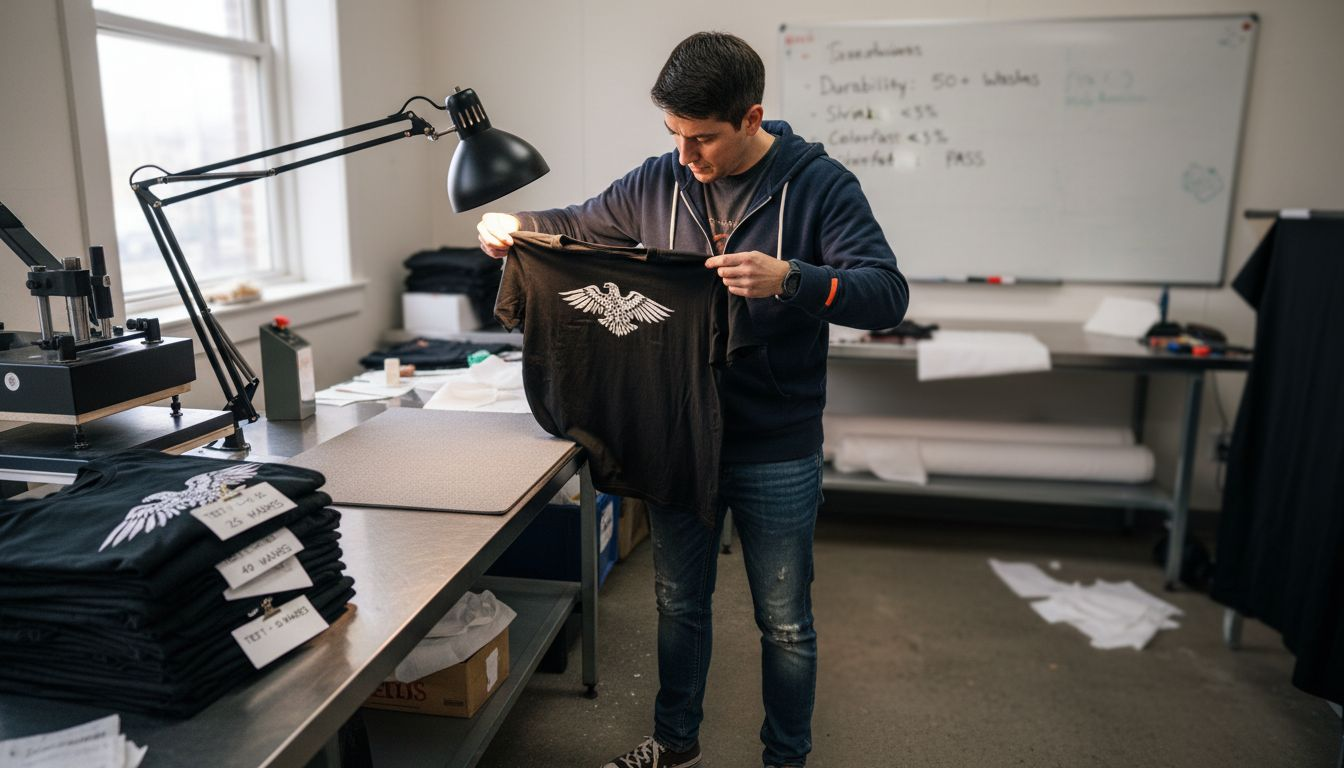
Durability testing shows DTF transfers withstand repeated washing when properly applied. The table below compares wash cycle performance across common printing methods:
| Printing Method | Average Wash Cycles | Color Retention | Adhesion Strength |
|---|---|---|---|
| DTF Transfers | 50-60 cycles | 90-95% | Excellent |
| DTG on Cotton | 40-50 cycles | 85-90% | Good |
| Screen Printing | 50-70 cycles | 95-100% | Excellent |
| Vinyl Heat Transfer | 30-40 cycles | 90-95% | Good to Excellent |
Adhesion strength depends on correct heat press parameters. DTF transfers require 305-320°F temperature, 10-15 seconds dwell time, and medium-heavy pressure. Following manufacturer specifications ensures the hot-melt adhesive fully bonds to fabric fibers.
Color retention statistics show DTF inks maintain vibrancy through 50+ wash cycles when garments are washed inside out with cold water. The polymer-based ink layer resists fading better than water-based DTG inks on polyester blends.
Pro Tip: Preheat garments for 3 to 5 seconds before applying DTF transfers to remove moisture and wrinkles. This simple step improves initial adhesion and extends transfer life.
Ensuring DTF print quality requires attention to both transfer production and application technique. Professional transfer services control production variables, leaving you responsible only for proper heat pressing. This division of labor minimizes quality issues and maintains consistent results.
Commercial apparel brands increasingly adopt DTF transfers because durability meets customer expectations. The combination of vibrant colors, soft hand feel, and wash resistance makes DTF suitable for retail products, promotional merchandise, and custom orders alike.
Explore Reliable Outsourced DTF Transfer Solutions
Maximizing the efficiency and quality benefits discussed throughout this guide requires partnering with experienced DTF transfer providers. DIY Printz specializes in high-volume transfer production, processing hundreds to thousands of orders monthly with consistent turnaround times.
Outsourcing to established providers eliminates the cost and complexity of printer ownership while delivering commercial-grade results. You gain access to professional equipment, expert color matching, and quality control processes without capital investment or technical training.
Whether you run a print shop, merch brand, embroidery operation, or design business, outsourced DTF transfers let you focus on what you do best: creating designs, serving customers, and growing revenue. The DTF printing apparel production guide walks you through order preparation, while the DTF transfer application guide ensures perfect heat press results every time.
Explore custom DTF transfer services to discover how outsourcing transforms your production workflow, reduces overhead costs, and enables scalable growth without equipment headaches.
Frequently Asked Questions About DTF Transfers
Can DTF transfers be applied to all fabric types?
Yes, DTF transfers work on cotton, polyester, blends, and nylon, covering most common apparel fabrics. Reputable outsourced providers confirm fabric compatibility before production to ensure optimal adhesion and durability.
What is the typical turnaround time for outsourced DTF transfers?
Turnaround times typically range from same day to a few business days depending on order volume and design complexity. Outsourcing often accelerates production compared to managing in-house printer maintenance and downtime.
Are DTF transfers environmentally friendly compared to other methods?
DTF uses water-based inks and generates minimal waste compared to screen printing’s chemical-heavy emulsion and reclamation processes. Choosing providers with proper waste disposal practices further reduces environmental impact.
How can I maintain the quality of DTF transfers after application?
Wash garments inside out with cold water and mild detergent to extend transfer life. Avoid bleach, fabric softeners, and dry cleaning, which can degrade adhesive bonds and fade colors prematurely.
What cost factors should small businesses consider with DTF transfers?
Upfront printer costs of $15,000 to $30,000 make ownership expensive; outsourcing eliminates this investment. Variable costs include per-transfer pricing based on size and quantity, with volume discounts available through established providers.
Recommended
READY TO PRINT?
Send us your artwork and we'll dial in your DTF transfer, color, and same-day turnaround.


