

Role of DIY printing in apparel production success 2026
Discover when DIY printing beats outsourcing for apparel businesses. Compare costs, profit margins, and hybrid models to maximize efficiency in 2026.

Many small apparel businesses assume buying DIY printing equipment guarantees lower costs and better control. The truth is more nuanced: upfront investments, material expenses, and maintenance demands can outweigh savings unless you consistently produce high volumes. Understanding when to invest in DIY printing versus outsourcing DTF transfers is critical for profitability and operational efficiency. This guide breaks down real cost benchmarks, profit margins, and decision frameworks to help you choose the smartest path for your apparel business in 2026.
Table of Contents
- Understanding The Real Costs Of Diy Printing
- Cost Comparison: Diy Vs Outsourcing
- Profitability Benchmarks And Business Impact Of Diy Vs Outsourcing
- Choosing Diy Printing Or Outsourcing: Decision Framework For Small Apparel Businesses
- Maximizing Efficiency With Hybrid Diy And Outsourcing Models
- Find Reliable Dtf Printing Solutions With Diy Printz
- Frequently Asked Questions
Key takeaways
| Point | Details |
|---|---|
| DIY printing requires significant upfront investment | Equipment costs around $10,000 plus ongoing material expenses of $0.80 to $2.00 per print |
| Outsourcing suits low to medium volumes | For businesses producing under 500 transfers monthly, outsourcing often delivers better ROI |
| Hybrid models boost revenue and speed | Combining DIY with outsourcing increases margins up to 15% and cuts turnaround times by 50% |
| Profit margins vary by production model | In-house printing yields $15 to $25 per shirt, outsourcing $5 to $15 depending on volume |
| DTF is replacing screen printing | 76% of shops now use hybrid or in-house DTF, generating 42% of revenue from DTF alone |
Understanding the real costs of DIY printing
Owning DTF printing equipment sounds appealing until you calculate the full financial picture. A basic DIY setup costs exceed $10,000 for the printer, heat press, and initial supplies. Material costs add another $0.80 to $2.00 per transfer depending on design complexity and ink coverage. These expenses don’t include maintenance, replacement parts, or the inevitable learning curve that slows early production.
Outsourcing DTF transfers typically costs $1 to $15 per print based on size, quantity, and turnaround speed. For small businesses producing fewer than 200 transfers monthly, outsourcing eliminates equipment risk and upfront capital. The break-even point sits between 174 and 500 transfers per month, meaning you need consistent volume to justify owning equipment.
Hidden costs erode DIY profitability faster than most owners anticipate. Printer maintenance requires regular cleaning, printhead replacements, and software updates. Downtime from technical issues can halt production for days, costing you orders and customer trust. Training staff to operate equipment efficiently takes weeks, and mistakes during this period waste expensive materials. Supply management adds another layer: tracking ink levels, ordering film and powder, and storing materials properly to prevent spoilage.
Volume consistency determines whether DIY printing makes financial sense. Businesses with steady monthly demand above 500 transfers can amortize equipment costs and achieve lower per-unit expenses. Seasonal or fluctuating demand makes outsourcing safer because you pay only for what you produce. The DIY fabric printing process guide explains production workflows that help you estimate realistic monthly output before committing to equipment.
Pro Tip: Calculate your average monthly transfer volume over six months, not just peak periods, to get an accurate break-even timeline. Overestimating consistent demand leads to underutilized equipment and wasted investment.
Cost comparison: DIY vs outsourcing
| Cost Factor | DIY Printing | Outsourcing |
|---|---|---|
| Initial Investment | $10,000+ equipment | $0 upfront |
| Per Transfer Cost | $0.80 to $2.00 | $1.00 to $15.00 |
| Monthly Break-Even | 174 to 500 transfers | No minimum |
| Maintenance | $500 to $1,500 annually | Included in price |
| Downtime Risk | High (equipment failure) | None (vendor responsibility) |
Key considerations for cost analysis:
- Equipment depreciation reduces resale value by 30% to 50% within two years
- Material waste during learning phase can exceed 20% of early production
- Outsourcing scales instantly without capacity constraints or space requirements
- DIY printing demands dedicated workspace with proper ventilation and electrical capacity
Profitability benchmarks and business impact of DIY vs outsourcing
Profit margins tell the real story behind DIY versus outsourced printing decisions. In-house DTF yields approximately $15 to $25 profit per shirt after material and labor costs, while outsourcing generates $5 to $15 per shirt. At 250 shirts monthly, first-year profits reach around $35,000 with DIY printing versus $24,000 with outsourcing. This $11,000 difference assumes zero equipment downtime, minimal waste, and efficient production from day one.
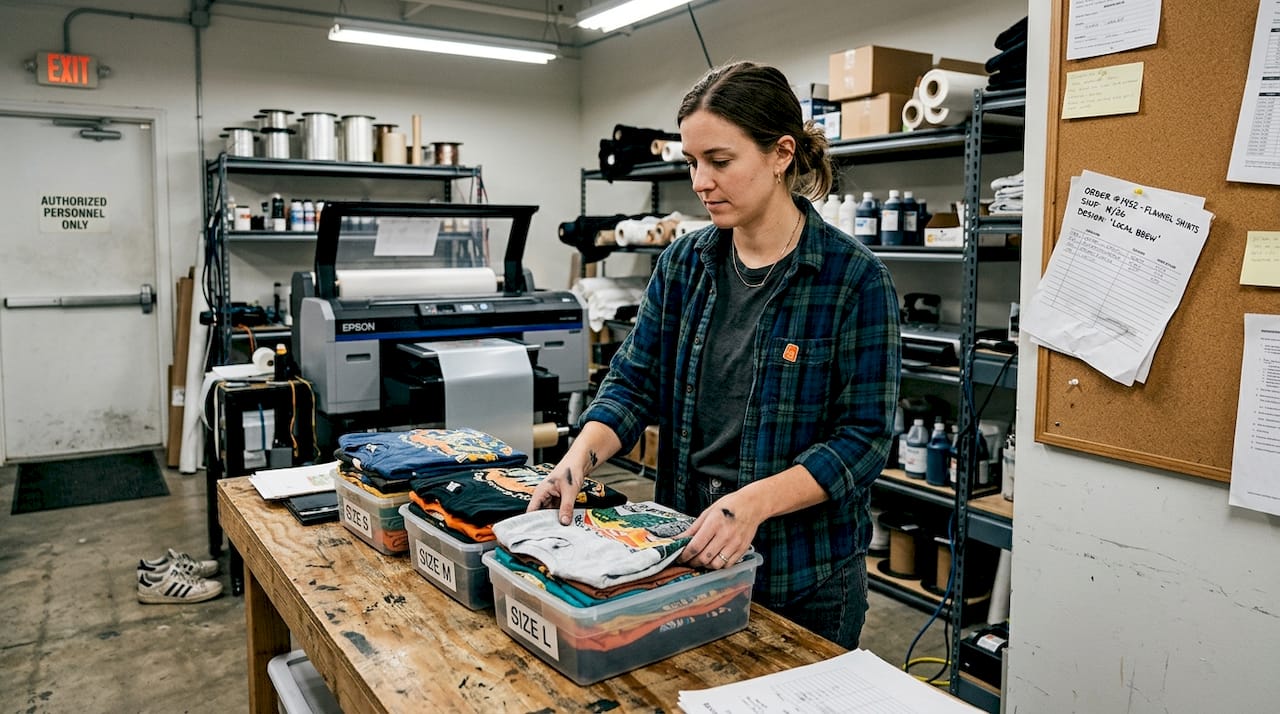
Scaling volume amplifies profit differences but also magnifies operational challenges. Producing 500 transfers monthly with in-house equipment can double annual profits compared to outsourcing. However, this requires consistent demand, skilled labor, and backup plans for equipment failure. Outsourcing offers predictable costs and eliminates the risk of idle equipment during slow periods. The benefits of DTF printing for apparel businesses include flexibility that protects cash flow when demand fluctuates.
Hybrid models are transforming small print shop economics. 76% of shops use in-house or hybrid DTF systems, generating 42% of total revenue from DTF production alone. These businesses blend DIY printing for core products with outsourcing for overflow, rush orders, or specialty items. This approach increases margins up to 15% while cutting turnaround times by 50%, giving small shops competitive advantages over larger operations locked into single production methods.
Screen printing is losing market share as DTF proves more profitable and versatile. Traditional screen printing requires minimum order quantities, long setup times, and limited color options. DTF handles single-item orders, full-color designs, and faster production cycles. Small shops adopting DTF report higher customer satisfaction and expanded product offerings. The DTF vs screen printing comparison highlights why businesses are shifting resources toward DTF capabilities.
Turnaround speed directly impacts customer retention and order volume. In-house printing can fulfill custom orders within 24 to 48 hours, while outsourcing typically requires three to seven days. Faster delivery enables premium pricing and repeat business. However, maintaining this speed requires backup equipment, trained staff, and efficient workflows that many small businesses struggle to sustain consistently.
Pro Tip: Track your actual production time per transfer, including setup and cleanup, for 30 days before deciding on DIY equipment. Most owners underestimate labor hours by 40% to 60%.
Profit comparison: DIY vs outsourcing at different volumes
| Monthly Volume | DIY Annual Profit | Outsourcing Annual Profit | Profit Difference |
|---|---|---|---|
| 100 transfers | $12,000 | $18,000 | Outsourcing wins by $6,000 |
| 250 transfers | $35,000 | $24,000 | DIY wins by $11,000 |
| 500 transfers | $78,000 | $42,000 | DIY wins by $36,000 |
| 1,000 transfers | $168,000 | $78,000 | DIY wins by $90,000 |
“The hybrid print shop model allows us to maximize margins on high-volume orders while outsourcing specialty work that would require expensive additional equipment. Our DTF revenue now exceeds screen printing by 30%, and customer satisfaction scores improved 25% due to faster turnaround times.”
Factors influencing profitability beyond raw margins:
- Customer acquisition costs decrease with faster turnaround and broader product options
- Equipment financing adds $200 to $400 monthly to DIY costs for three to five years
- Outsourcing frees staff time for sales, design, and customer service activities
- In-house printing enables same-day rush orders at premium pricing
Choosing DIY printing or outsourcing: decision framework for small apparel businesses
Volume thresholds provide the clearest starting point for your decision. Outsourcing is recommended for businesses producing fewer than 174 transfers monthly to avoid expensive equipment and operational complexity. DIY printing makes financial sense when you consistently produce 500 or more transfers and have the infrastructure to support daily production. Between these thresholds, your decision depends on growth trajectory, capital availability, and operational capacity.
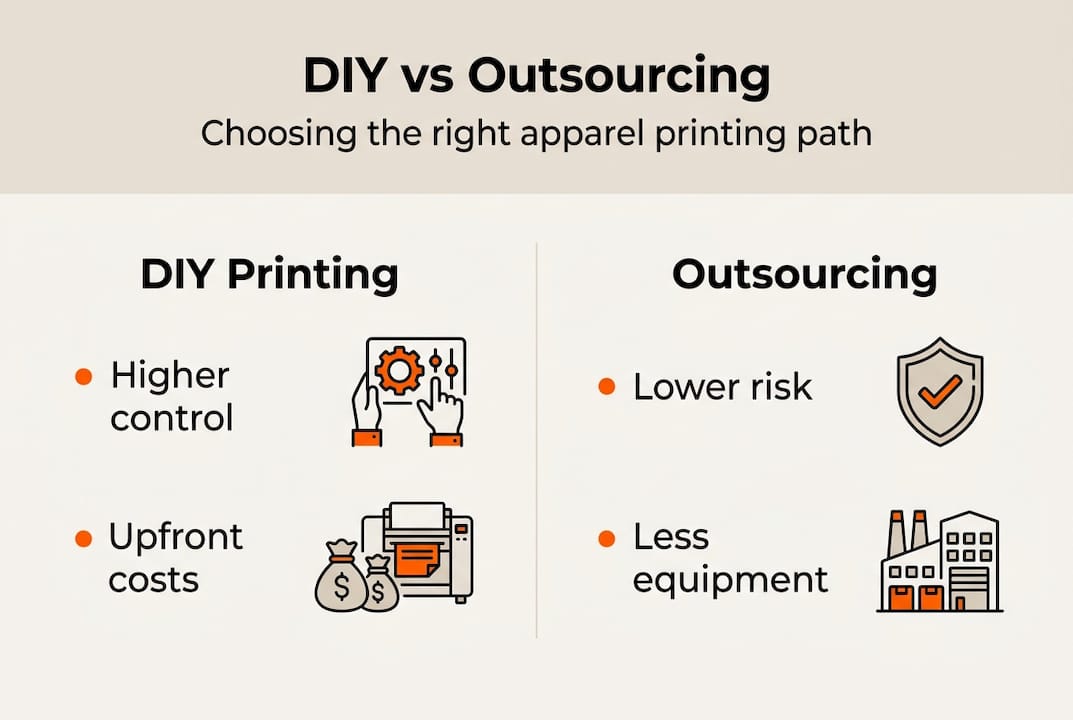
Budget considerations extend far beyond initial equipment purchase. Calculate total cost of ownership including maintenance contracts, replacement parts, material inventory, and potential financing costs. Factor in opportunity costs: money invested in equipment can’t fund marketing, inventory expansion, or other growth initiatives. Outsourcing preserves capital and converts fixed costs into variable expenses that scale with revenue.
Operational capacity determines whether you can sustain consistent DIY production. Evaluate these factors honestly:
- Do you have dedicated space with proper ventilation, electrical capacity, and climate control?
- Can you afford staff training time of four to eight weeks before reaching full efficiency?
- Do you have backup plans for equipment downtime, including alternative production methods or vendor relationships?
- Can you manage supply chain logistics for ink, film, powder, and maintenance supplies?
- Do you have technical support resources or internal expertise to troubleshoot equipment issues?
- Can you maintain quality control standards consistently across all production runs?
Hybrid approaches offer the best of both models for many small businesses. Start with outsourcing to test demand and refine your product offerings. As volume grows and patterns stabilize, invest in DIY equipment for your most popular items while continuing to outsource specialty work, overflow, or rush orders. This gradual transition minimizes risk and allows you to build expertise before committing fully to in-house production. The DIY printing benefits for small businesses include flexibility to adapt as your market evolves.
Product variety and turnaround demands shape your production strategy. Businesses offering hundreds of design options benefit from outsourcing because they avoid maintaining large material inventories. Companies focusing on a core product line with consistent branding can optimize DIY workflows for maximum efficiency. Customer expectations for delivery speed may force your hand: if competitors deliver in 48 hours, you need production capabilities that match or exceed that standard.
Pro Tip: Create a 12-month demand forecast including seasonal peaks and valleys before investing in equipment. Most small businesses experience 40% to 60% volume fluctuation throughout the year, making consistent break-even difficult to achieve.
Scalability and flexibility considerations:
- DIY equipment capacity limits growth unless you invest in additional machines
- Outsourcing scales instantly to handle 10x volume spikes without capital investment
- Hybrid models provide insurance against demand uncertainty
- Geographic expansion is easier with outsourcing partners who ship nationally
- Equipment resale markets are limited, making exit strategies difficult with DIY investments
The cost-effective transfer printing guide walks through detailed scenarios to help you model your specific situation with real numbers.
Maximizing efficiency with hybrid DIY and outsourcing models
Hybrid print shops represent the fastest-growing segment in apparel production. These businesses use DIY printing for predictable, high-volume orders while outsourcing specialty jobs, overflow work, or items requiring equipment they don’t own. This strategic combination increases margins up to 15% compared to pure outsourcing and reduces risk compared to full DIY operations. 76% of small shops now operate as hybrid or in-house facilities, with DTF revenue comprising 42% of total income.
Revenue diversification through transfer sales creates unexpected profit centers. Shops with DIY equipment sell ready-to-press transfers to other businesses, DIY hobbyists, and makers who lack printing capabilities. This B2B revenue stream utilizes excess capacity during slow periods and builds relationships with potential wholesale customers. Some hybrid shops report transfer sales generating 20% to 30% of monthly revenue with minimal additional marketing effort.
Product offering expansion becomes possible without proportional cost increases. Hybrid shops can test new product categories by outsourcing initial production, then bring successful items in-house once demand justifies equipment investment. This approach eliminates the risk of buying specialized equipment for unproven products. The examples of DIY apparel printing showcase diverse applications that hybrid models enable.
Risk mitigation through vendor relationships protects against equipment failure and capacity constraints. Maintaining active outsourcing partnerships ensures continuity when DIY equipment requires maintenance or breaks down. These relationships also provide surge capacity during peak seasons without forcing you to own equipment that sits idle most of the year. Smart hybrid operators negotiate volume discounts with outsourcing partners based on consistent overflow work.
Operational efficiency improves when you match production methods to order characteristics. Use DIY equipment for simple, repeatable designs with established workflows. Outsource complex, one-off designs that require extensive setup or specialized materials. This selective approach maximizes your equipment utilization rate and minimizes production bottlenecks. The BYO custom T-shirt printing options article explains how to structure product offerings around hybrid capabilities.
Pro Tip: Negotiate retainer agreements with outsourcing partners that guarantee capacity and pricing in exchange for minimum monthly volume. This protects your hybrid model during equipment downtime or unexpected demand spikes.
Key advantages of hybrid models:
- Flexibility to accept orders beyond current equipment capacity
- Reduced capital requirements compared to full in-house operations
- Ability to test new markets and products with minimal investment
- Insurance against equipment obsolescence as technology evolves
- Faster adaptation to changing customer preferences and industry trends
- Lower fixed costs during seasonal slowdowns or economic uncertainty
Hybrid operations require clear decision frameworks to avoid confusion and inefficiency. Establish volume thresholds, complexity criteria, and turnaround requirements that determine whether each order goes to DIY production or outsourcing. Document these rules and train staff to apply them consistently. Review and adjust criteria quarterly based on actual costs, capacity utilization, and profit margins.
Find reliable DTF printing solutions with DIY Printz
Whether you’re evaluating DIY equipment or optimizing a hybrid production model, partnering with a proven outsourcing provider protects your profitability and operational flexibility. DIY Printz specializes in high-volume DTF transfer production, delivering hundreds to thousands of orders monthly with consistent quality and fast turnaround. We handle the complete transfer printing process so you can focus on selling, pressing, and growing your apparel business without equipment headaches.
Our flexible order sizes accommodate businesses at every stage, from small test runs to bulk production that scales with your success. Print shops, merch brands, and DIY enthusiasts rely on DIY Printz to eliminate the cost, maintenance, and learning curve of owning DTF equipment while maintaining the quality and speed their customers demand. Explore our resources and services to discover how outsourcing transfers can boost your margins and simplify your operations in 2026.
Frequently asked questions
Is DIY printing worth it for small apparel businesses?
DIY printing becomes worthwhile when you consistently produce 500 or more transfers monthly and have the capital, space, and expertise to manage equipment properly. Below this threshold, outsourcing typically delivers better ROI by eliminating upfront investment, maintenance costs, and downtime risks. Your decision should factor in volume stability, growth projections, and whether capital invested in equipment could generate higher returns through marketing or inventory expansion.
What is the cost break-even point for DIY printing vs outsourcing?
Break-even typically occurs between 174 and 500 transfers per month depending on equipment costs, material expenses, and operational efficiency. This range accounts for the $10,000+ initial investment, ongoing maintenance, and material costs of $0.80 to $2.00 per transfer. Businesses with inconsistent volume may never reach break-even because equipment sits idle during slow periods, extending the payback timeline indefinitely.
How do hybrid print shops benefit small business owners?
Hybrid shops gain up to 15% higher margins and 50% faster turnaround by combining DIY printing for core products with outsourcing for specialty work and overflow. This model reduces capital requirements, provides surge capacity during peak seasons, and enables product diversification without proportional equipment investment. Many hybrid operators also sell DTF transfers to other businesses, creating additional revenue streams that utilize excess equipment capacity.
Can small print shops compete with large operations using DIY printing?
Small shops excel through agility, speed, and niche focus that large operations can’t match. DIY or hybrid models enable same-day turnaround, personalized customer service, and rapid adaptation to local market trends. Large operations have economies of scale but higher fixed costs, slower decision making, and less flexibility to customize offerings. Small businesses win by delivering exceptional service and specialized products rather than competing on price alone.
Recommended
READY TO PRINT?
Send us your artwork and we'll dial in your DTF transfer, color, and same-day turnaround.


