

T-shirt printing tips 2026 for small businesses
Master t-shirt printing in 2026 with expert tips on choosing methods, optimizing costs, and matching techniques to order size and design complexity for small businesses.

Choosing the right t-shirt printing method can make or break your business in 2026. With multiple technologies available, each offering different strengths for design complexity, order volume, and fabric types, the decision requires careful evaluation. Small business owners and DIY enthusiasts need practical guidance to match printing methods with their specific project needs, balancing cost efficiency against quality demands. This article delivers expert tips to help you select and apply the most efficient printing techniques for your apparel business.
Table of Contents
- How To Evaluate T-Shirt Printing Options In 2026
- Screen Printing: Top Tips For Bulk T-Shirt Orders
- DTG Printing: A Flexible Choice For Detailed And Small-Batch Designs
- Comparing Methods And Choosing What’s Best For Your Business In 2026
- Boost Your T-Shirt Printing Business With DIY Printz
Key takeaways
| Point | Details |
|---|---|
| Screen printing wins for bulk | Orders over 50 shirts achieve lowest per-unit costs with screen printing setup |
| DTG suits detailed artwork | Full-color designs with gradients and photos print best using direct-to-garment technology |
| Fabric dictates method choice | Cotton works for screen printing and DTG, while polyester requires sublimation |
| Volume drives economics | Small batches favor digital methods, high volume justifies screen printing investment |
| Testing prevents waste | Sample prints on actual fabric reveal quality issues before committing to production runs |
How to evaluate t-shirt printing options in 2026
Order quantity stands as the primary factor when selecting your printing approach. Screen printing requires upfront setup costs for screens and color separations, making it expensive for small batches but incredibly economical once you hit 50 or more units. Digital methods like DTG eliminate setup fees entirely, making them perfect for orders ranging from one to fifty shirts.
Design complexity determines which technologies can actually reproduce your artwork. Simple logos with two or three solid colors work beautifully with screen printing, while intricate photographs or designs with color gradients demand the precision of digital printing. Screen printing struggles with fine details and smooth color transitions that DTG handles effortlessly.
Fabric choice impacts print quality significantly across different methods. Cotton and cotton-rich blends provide ideal surfaces for screen printing and DTG, absorbing inks properly for vibrant, durable results. Polyester fabrics require sublimation printing, where heat transforms solid dye into gas that bonds with synthetic fibers. Blended fabrics create challenges, often requiring testing to determine which method yields acceptable quality.
Budget constraints and turnaround expectations shape realistic options for your project. Screen printing demands higher initial investment but delivers lower per-shirt costs at volume. DTG offers faster setup and production for rush orders but costs more per unit. Understanding your financial limits and delivery deadlines helps narrow viable choosing printing methods for your specific situation.
Pro Tip: Always order test prints on your exact fabric choice before committing to full production runs, as different material compositions can dramatically alter ink adhesion, color vibrancy, and wash durability.
Screen printing: top tips for bulk t-shirt orders
Screen printing is cost-effective for orders exceeding 50 shirts because setup costs get distributed across many units. Each color in your design requires a separate screen, and creating these screens plus mixing custom ink colors involves labor and materials. Once screens are prepared, printing becomes fast and inexpensive, making the per-shirt cost drop dramatically as quantity increases.
Thick ink deposits create the signature durability and opacity that makes screen printing ideal for cotton garments. The plastisol or water-based inks sit on top of fabric fibers rather than soaking in, producing bold colors that withstand hundreds of wash cycles. This characteristic makes screen printing the preferred choice for promotional shirts, team uniforms, and any application where longevity matters more than photographic detail.
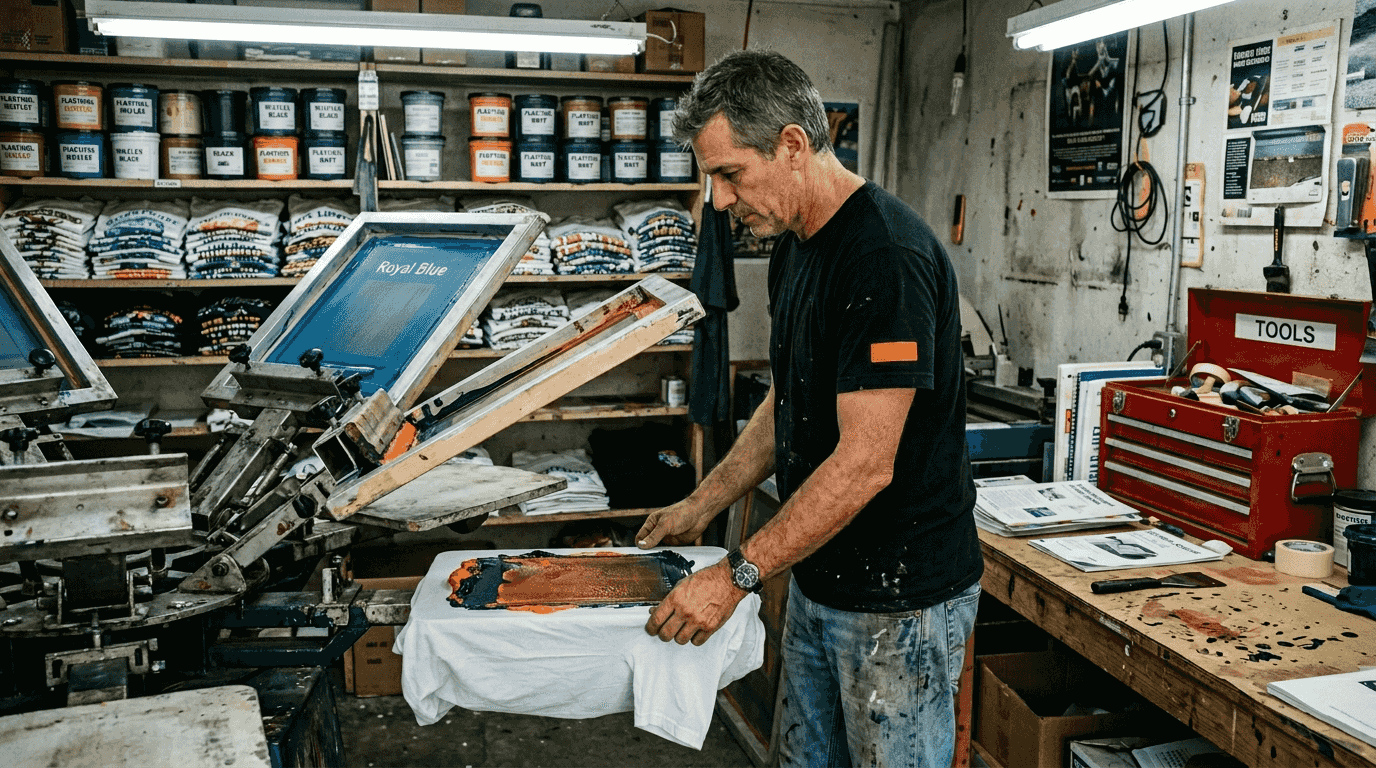
Color limitations represent the main constraint with screen printing technology. Each additional color adds another screen, increasing setup time and costs. Designs with five or more colors become expensive and complex to produce. Gradients and subtle color transitions prove nearly impossible, as screen printing excels with solid, distinct color areas rather than smooth blends.
Mesh count selection directly impacts print sharpness and ink deposit thickness. Lower mesh counts (110-160 threads per inch) allow more ink through, creating bold, opaque prints perfect for dark garments. Higher mesh counts (200-305 threads per inch) produce finer detail and thinner ink layers suitable for light fabrics and detailed artwork. Matching mesh count to your design requirements separates amateur results from professional quality.
Key considerations for successful screen printing projects:
- Setup costs justify orders of 50+ shirts minimum
- Best for designs with 1-4 solid colors
- Cotton and cotton blends provide ideal printing surfaces
- Durable prints withstand commercial washing
- Requires proper screen tension and registration
Pro Tip: Convert multicolor designs to spot colors whenever possible, as each eliminated color reduces both setup costs and potential registration problems during screen printing advantages production runs.
DTG printing: a flexible choice for detailed and small-batch designs
DTG printing is ideal for reproducing photographs, illustrations with subtle shading, and designs featuring unlimited colors. The technology works like an inkjet printer, spraying water-based inks directly onto fabric fibers. This approach eliminates screens entirely, making setup instantaneous and enabling true print-on-demand capabilities for businesses serving custom orders.
Small batch economics favor DTG printing because zero setup costs mean the first shirt costs the same as the hundredth. This pricing structure revolutionizes business models, allowing entrepreneurs to offer extensive design catalogs without inventory risk. You can test new designs with single-unit orders, scaling production only after confirming customer demand.
Cotton content determines DTG print quality more than any other factor. Pure cotton or blends with 80% or higher cotton content absorb water-based inks beautifully, producing vibrant colors and soft hand feel. Polyester fibers repel water-based inks, causing colors to appear faded and washed out. Blends below 50% cotton rarely produce acceptable results with DTG technology.
Pre-treatment application represents the critical step most beginners overlook in the DTG printing process guide. Spraying or coating garments with pre-treatment solution before printing helps inks bond properly with fabric fibers and prevents colors from bleeding. Dark garments require heavier pre-treatment to create a base for white ink, which provides opacity for color layers printed on top.
Production speed limitations make DTG less suitable for rush orders exceeding 50 shirts. Each garment requires individual printing, pre-treatment drying, and heat curing, typically taking 3-5 minutes per shirt. Screen printing produces 100+ shirts per hour once setup completes, making it far faster for volume work despite longer preparation time.
| DTG Printing Factor | Best Practice | Common Mistake |
|---|---|---|
| Fabric selection | 100% cotton or 80%+ cotton blends | Using polyester or low-cotton blends |
| Pre-treatment | Even coating, proper drying time | Skipping or uneven application |
| White underbase | Appropriate thickness for garment color | Too thin on dark shirts |
| Curing temperature | Follow ink manufacturer specifications | Insufficient heat or time |
Pro Tip: Apply white underbase strategically on darker garments to make colors pop without adding excessive ink weight, as multiple thin layers often produce better results than one thick pass while exploring DTF printing benefits.
Comparing methods and choosing what’s best for your business in 2026
Screen printing delivers unmatched economics for standardized designs produced in volume. The break-even point typically occurs around 50-75 shirts, where the per-unit cost drops below DTG pricing. Simple designs with limited colors on cotton shirts represent the ideal screen printing scenario, combining low production costs with excellent durability. Organizations ordering team uniforms, event shirts, or promotional merchandise in consistent quantities benefit most from this traditional approach.
DTG printing serves businesses prioritizing design flexibility and low inventory risk. The ability to print single units economically enables extensive product catalogs without warehousing costs. Design complexity and quantity both favor DTG when artwork includes photographs, gradients, or more than four colors. Print-on-demand operations, custom gift businesses, and artists testing new designs find DTG technology essential for their business models.
Sublimation printing creates permanent, vibrant designs on polyester fabrics by converting solid dye into gas that bonds with synthetic fibers. Consider the fabric type carefully, as polyester content must exceed 65% for acceptable results, with 100% polyester producing the brightest colors. This method excels for athletic wear, all-over prints, and applications where design covers the entire garment. The limitation to synthetic fabrics restricts sublimation to specific market niches.
| Method | Best Order Size | Ideal Fabric | Design Suitability | Cost Structure |
|---|---|---|---|---|
| Screen Printing | 50+ shirts | Cotton, cotton blends | Simple, 1-4 colors | High setup, low per-unit |
| DTG Printing | 1-50 shirts | Cotton, high-cotton blends | Complex, unlimited colors | No setup, moderate per-unit |
| Sublimation | Any quantity | Polyester only | Full-color, all-over prints | Low setup, moderate per-unit |
| DTF Transfers | 1-1000+ shirts | Any fabric type | Any complexity | Minimal setup, scalable |
Decision factors for your specific business needs:
- Match method to your typical order quantities
- Evaluate design complexity against method capabilities
- Consider fabric preferences of your target customers
- Calculate total costs including setup and per-unit pricing
- Factor in turnaround time requirements
Hybrid approaches often serve growing businesses best, using screen printing for high-volume standard items while maintaining DTG capability for custom orders. This strategy optimizes costs across your product mix while preserving flexibility for customer requests. Many successful print shops invest in multiple technologies, selecting the most economical method for each specific project rather than forcing all work through a single process. Understanding when to use each approach through transfer printing choices separates profitable operations from struggling competitors.
Boost your t-shirt printing business with DIY Printz
Mastering multiple printing methods requires significant investment in equipment, training, and maintenance. Many small businesses and DIY enthusiasts find outsourcing transfer production more profitable than managing in-house printing operations.
DIY Printz delivers professional same day DTF transfers that combine the quality of screen printing with the flexibility of digital methods. Our high-volume production capabilities serve everyone from hobbyists testing designs to established brands fulfilling thousands of orders monthly. You simply press our ready-made transfers onto garments, eliminating the complexity of maintaining printers, mixing inks, and troubleshooting equipment failures. Explore our full range of solutions at DIY Printz to discover how outsourcing transfer production lets you focus on growing your brand while we handle the technical printing challenges.
Frequently asked questions
What are the best printing methods for small t-shirt orders?
DTG and DTF printing excel for small orders because they eliminate expensive screen setup costs that make traditional methods uneconomical below 50 units. DTG works best on cotton garments for designs with complex colors and gradients. DTF transfers offer even greater flexibility, working on any fabric type while maintaining excellent durability and color vibrancy. Both methods enable true print-on-demand business models.
How does fabric choice affect t-shirt printing results?
Cotton and cotton-rich blends provide ideal surfaces for screen printing and DTG, as natural fibers absorb inks properly for vibrant, long-lasting prints. Polyester requires sublimation printing, where heat bonds dye directly with synthetic fibers. Fabric selection impacts ink adhesion, color brightness, wash durability, and overall print quality more than most other factors. Always test your chosen method on actual production fabric before committing to large orders.
What should small businesses consider when choosing a printing method in 2026?
Balance upfront investment against your typical order sizes and design complexity requirements. DTG offers maximum flexibility for on-demand printing and testing new designs without inventory risk. Screen printing reduces per-unit costs dramatically once order quantities exceed 50 shirts, making it ideal for standardized products. Consider outsourcing transfer production to avoid equipment costs, maintenance headaches, and the learning curve associated with mastering printing technologies in-house.
How many shirts make screen printing more economical than digital methods?
Screen printing typically becomes more cost effective than DTG around 50 to 75 shirts, depending on design complexity and number of colors. Setup costs for screens and color separations create a fixed expense that gets distributed across all units in the order. The more shirts you print, the lower the per-unit cost drops. Digital methods maintain consistent per-shirt pricing regardless of quantity, making them ideal for smaller runs.
Can DTG printing produce durable prints that withstand frequent washing?
Properly executed DTG prints on appropriate cotton fabrics withstand hundreds of wash cycles when cured correctly. The key factors include adequate pre-treatment application, proper ink saturation, and complete heat curing at manufacturer-specified temperatures. Water-based inks penetrate fabric fibers rather than sitting on the surface, creating a soft hand feel that improves with washing. Poor technique or wrong fabric choices lead to premature fading and cracking.
Recommended
READY TO PRINT?
Send us your artwork and we'll dial in your DTF transfer, color, and same-day turnaround.


