

What Is Transfer Printing? Streamlining Apparel Production
What is transfer printing and how does it work? Learn about types, process steps, pros and cons, and how it compares to direct printing methods.

Finding ways to expand your apparel product line without hefty investment can feel overwhelming for many small business owners and DIY creators. The need for vibrant designs, fast turnaround, and reliable results drives the search for smarter alternatives. Outsourced DTF transfer printing offers a cost-effective solution that lets you create complex, durable designs on a range of fabrics, supporting quick design updates and small batch runs to match dynamic market demands.
Table of Contents
- Transfer Printing Explained for Apparel Businesses
- Common Types of Transfer Printing Methods
- Step-By-Step Process of Transfer Printing
- Benefits and Drawbacks for Small Brands
- Transfer Printing Versus Direct-To-Garment Printing
Key Takeaways
| Point | Details |
|---|---|
| Transfer Printing Process | This method separates design printing from fabric application, using heat and pressure to transfer designs onto garments for durable results. |
| Flexibility and Speed | Transfer printing allows for complex designs with low minimum orders, enabling quick adaptation to market trends. |
| Cost Effectiveness | By outsourcing transfer printing, apparel businesses avoid expensive equipment costs while benefiting from predictable quality and inventory management. |
| Method Comparison | Transfer printing is superior for polyester and mixed fabrics, while direct-to-garment (DTG) printing is best for cotton; choose based on primary fabric needs. |
Transfer Printing Explained for Apparel Businesses
Transfer printing is a two-step process that separates design printing from fabric application. First, your design gets printed onto an intermediary material like paper or film. Then heat and pressure transfer that design onto your finished apparel.
This method flips the traditional approach on its head. Instead of printing directly onto fabric, you print onto a temporary carrier first. The design transfers when heat activates special inks, creating permanent results.
How Transfer Printing Works
The magic happens through a simple but precise process:
- Design gets printed onto transfer paper or film using specialized inks
- Transfer is placed face-down on your garment
- Heat press applies controlled temperature and pressure
- Design permanently bonds to the fabric fibers
- Carrier material peels away, leaving only the print
Different transfer types use different inks. Sublimation dyes vaporize under heat to penetrate polyester fibers, creating vibrant, durable prints. Water-based inks work on cotton. Each approach produces different results depending on your fabric choice.
The process leverages heat and pressure to achieve precise pattern transfer while maintaining design integrity across production runs.
Why Apparel Businesses Choose Transfer Printing
Transfer printing solves real problems small business owners and DIY creators face every day.
Design flexibility tops the list. You can create complex, multi-color designs on paper far easier than printing directly onto fabric. Want photorealistic images or intricate artwork? Transfer printing handles it without compromise.
Low minimum orders change the game for your business model:
- Print single pieces without wasteful setup costs
- Test new designs with minimal financial risk
- Scale production gradually as demand grows
- Avoid bulk inventory sitting in storage
Speed matters too. Transfer prints enable rapid design changes and small batch runs, supporting businesses facing dynamic market demands. You respond to trends instead of chasing yesterday’s inventory.
Production efficiency increases significantly. Your workflow becomes cleaner and more predictable when you outsource transfer production to a reliable partner like DIY Printz.
Cost Advantages for Your Business
Transfer printing reduces operational friction and storage headaches. You eliminate expensive DTF printer equipment, ongoing maintenance costs, and the learning curve that comes with ownership.
Ordermore precisely based on customer demand. No overproduction guesswork. No warehouse space consumed by overstocked inventory.
Quality remains consistent across orders. Professional production means every transfer meets the same standards, building trust with your customers.
Here’s how transfer printing impacts common business factors:
| Business Factor | Positive Outcome | Potential Challenge |
|---|---|---|
| Startup Investment | No equipment purchase needed | Initial reliance on suppliers |
| Design Changes | Rapid updates and variations | Must coordinate with provider |
| Inventory Management | On-demand, low inventory risk | Longer fulfillment for large runs |
| Production Scale | Easy to scale gradually | May face per-unit cost limits |
Pro tip: Start with small test orders of new designs using transfer printing before committing to bulk production, letting customer feedback guide your inventory decisions.
Common Types of Transfer Printing Methods
Transfer printing isn’t one-size-fits-all. Different methods work better for different fabrics, designs, and production volumes. Understanding your options helps you choose the right approach for your apparel business.
Each method has distinct advantages and limitations. The choice depends on your fabric type, design complexity, production volume, and durability requirements. Let’s break down the main options you’ll encounter.
Sublimation Transfer Printing
Sublimation transfer is the workhorse of modern apparel production. Dyes are printed onto paper, then heat causes them to vaporize and bond directly into polyester fibers. The result? Vibrant, permanent prints that don’t fade.
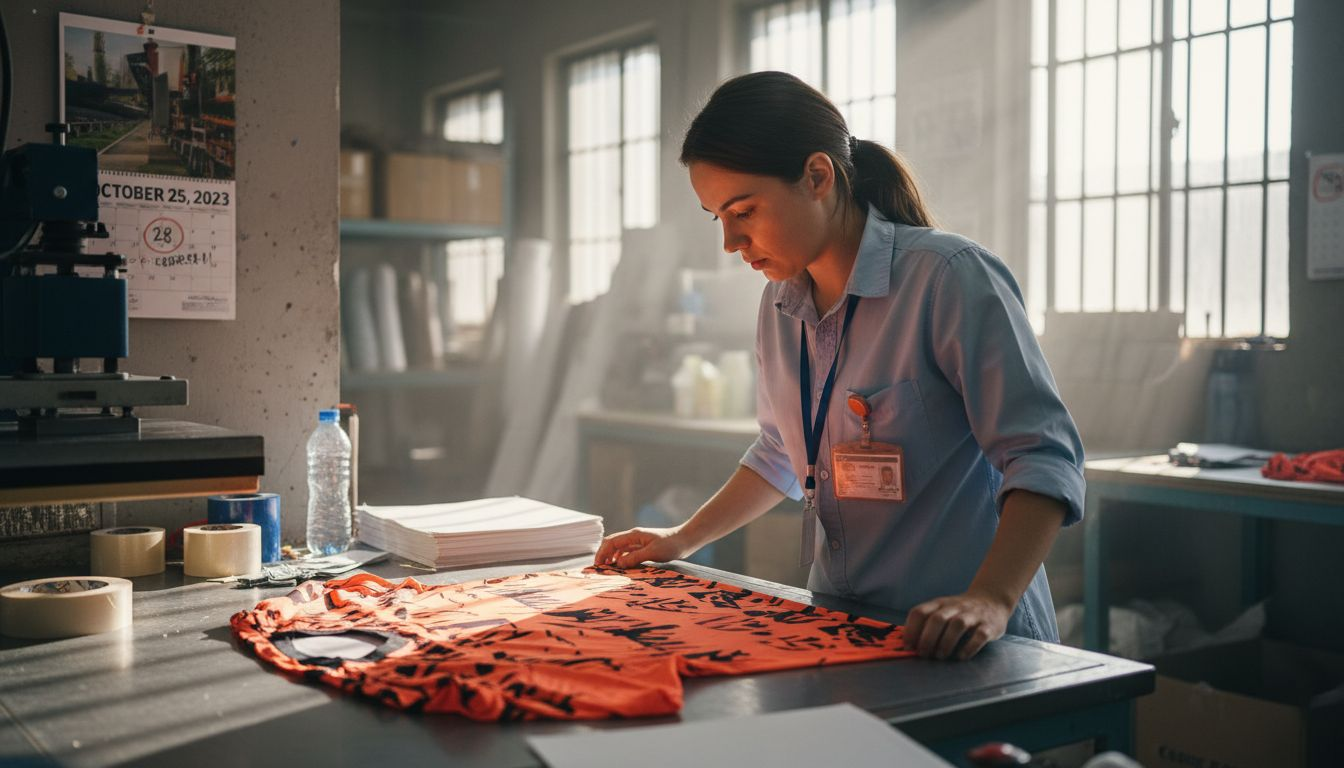
This method excels for synthetic fabrics like polyester and nylon. The dyes literally become part of the fiber structure, creating durability that outlasts screen printing. Sublimation transfer remains commercially significant for printing on polyester fabrics across the apparel industry.
Key advantages include:
- Photorealistic color reproduction
- No visible ink layer on fabric
- Excellent wash and fade resistance
- Suitable for all-over prints
The downside? It only works on light-colored polyester. Cotton and dark fabrics aren’t compatible with this process.
Film Release Transfer Printing
Film release transfer uses a flexible film printed with your design. Heat and pressure press this film onto the garment, transferring the design in the process.
This method offers flexibility across fabric types. It works on cotton, polyester, blends, and even dark fabrics. You get vibrant colors without dye sublimation limitations.
The process is straightforward:
- Design prints onto transfer film
- Film is cut to design shape
- Heat press bonds film to garment
- Carrier film peels away cleanly
Film release transfer provides versatility across multiple fabric types and colors, making it ideal for diverse apparel production needs.
Heat Transfer Printing
Heat transfer printing is the umbrella term covering multiple techniques. It involves applying heat and pressure to transfer designs from paper or film to fabric.
This category includes sublimation, film release, and other specialized methods. The common factor? Heat activates the transfer process. Different ink formulations and substrates create different results for different applications.
Comparing Transfer Methods
Choosing the right method matters for your bottom line:
| Method | Best Fabric | Color Range | Durability | Cost |
|---|---|---|---|---|
| Sublimation | Polyester | All colors | Excellent | Moderate |
| Film Release | Cotton/Poly | All colors | Very good | Moderate |
| Heat Transfer | Multiple | Multiple | Varies | Varies |
Below, see how the main transfer printing methods compare on everyday apparel needs:
| Printing Method | Best For | Typical Use Case | Wash Durability |
|---|---|---|---|
| Sublimation | Polyester garments | Sportswear, activewear | Excellent—long lasting |
| Film Release | Mixed fabrics | Fashion tees, dark apparel | Very good—few issues |
| Heat Transfer | Custom applications | Novelty, promotional items | Varies—depends on type |
Small businesses benefit from outsourcing transfer production. You avoid buying equipment, learning different methods, and managing quality consistency. That’s where DIY Printz comes in—we handle the technical complexity so you focus on sales and fulfillment.
Pro tip: Match your transfer method to your primary fabric type and target market, then outsource production to a reliable partner who can execute consistently across multiple orders.
Step-By-Step Process of Transfer Printing
Transfer printing follows a straightforward workflow from design to finished product. Understanding each stage helps you manage expectations and communicate effectively with your production partner. Let’s walk through how the process actually works.
The journey from concept to wearable product involves multiple precision steps. Each one matters for quality and consistency. When you outsource to DIY Printz, we handle the technical complexity while you focus on your business.
Stage 1: Design and Digital Proofing
Everything starts with your artwork. You provide the design file, and the production team reviews it for technical requirements. Digital proofing ensures the design will translate correctly to the transfer medium.
Design checks include:
- Color accuracy and compatibility
- Resolution and image quality
- Sizing for your target garments
- File format compatibility
- Any special effects or finishes
This stage catches problems before production begins. A solid proof prevents costly reprints and delays.
Stage 2: Printing and Transfer Preparation
Your approved design gets printed onto transfer paper or film using specialized inks. The design is precisely printed and cut to exact specifications, preparing it for application to garments.
The transfer substrate—whether paper, film, or specialty material—receives the design with perfect registration and color accuracy. The printed transfer is then carefully cut to size, accounting for bleed and placement requirements.
Quality checks happen at this stage to verify print clarity and ink coverage.
Stage 3: Application to Garment
Now the transfer moves to your apparel. The transfer is positioned on the garment surface with precise alignment.
Heat and pressure activate the adhesion process. A heat press applies controlled temperature and force to bond the transfer to the fabric permanently. This is where the magic happens—the design becomes part of the garment.
Key variables managed during this stage:
- Precise temperature settings
- Pressure levels
- Application time
- Pressure release techniques
Stage 4: Curing and Quality Control
After pressing, the garment cools completely. Some methods require additional curing in an oven to fully fuse the design into fabric fibers.
Once cool, quality inspectors examine every transfer. They check for:
- Complete color transfer
- Proper adhesion
- No wrinkles or bubbles
- Correct placement
- Overall durability
Professional quality control ensures every garment meets standards before reaching your customers.
Stage 5: Packaging and Shipment
Approved garments get carefully packaged to prevent damage during transit. They’re ready for you to press, fulfill orders, or resell.
With DIY Printz, you receive ready-to-press transfers or finished garments depending on your needs. No quality surprises. No unexpected rejections.
Pro tip: When outsourcing transfer printing, request sample proofs before committing to full production runs, allowing you to verify color accuracy and sizing before scaling to large orders.
Benefits and Drawbacks for Small Brands
Transfer printing isn’t perfect for every situation, but for many small brands it solves critical business problems. Let’s be honest about what it does well and where it falls short.
Understanding both sides helps you decide if transfer printing fits your workflow. Some benefits are game-changers for your bottom line. Some drawbacks require planning to minimize impact.
The Real Benefits for Small Operations
Lower startup costs compared to screen printing make transfer printing accessible. You skip expensive equipment purchases, maintenance contracts, and technical training. That capital stays in your bank account.
Small batch production becomes economical. You’re not forced to print thousands of units to justify setup fees. Print one shirt today, fifty tomorrow, a hundred next week.
Design flexibility changes your product development speed:
- Complex multi-color designs require minimal technical skill
- Photorealistic images transfer cleanly onto garments
- Design changes happen without equipment adjustments
- Fast turnarounds enable responsive inventory management
You test new designs with minimal financial risk. If a design doesn’t sell, you didn’t waste thousands on inventory.
On-demand production aligns inventory with actual customer demand. No overstock gathering dust. No cash tied up in slow-moving inventory.
Transfer printing enables small brands to compete on design flexibility and speed without the capital investment required by traditional printing methods.
The Honest Drawbacks
Fabric limitations exist depending on transfer type. Sublimation works beautifully on polyester but struggles with cotton. Some transfer techniques present durability challenges depending on materials and application methods.
Test garments in your target market before scaling production. Wash testing reveals adhesion or fading issues before customers discover them.
Per-unit costs run higher than massive screen-printed runs. If you’re printing 10,000 identical shirts, screen printing wins on price. For diverse orders and small quantities, transfer printing remains competitive.
Technical expertise matters. Quality varies between providers. A reliable partner like DIY Printz ensures consistency. A careless supplier delivers problems.
Common drawbacks include:
- Higher per-unit costs vs. bulk screen printing
- Fabric-type restrictions on some methods
- Variable durability depending on transfer type
- Reliance on supplier quality and consistency
Outsourcing Eliminates the Biggest Drawbacks
When you partner with a professional DTF transfer supplier, many downsides disappear. You avoid equipment investment, technical learning curves, and quality inconsistency.
Your supplier handles durability testing and optimization. You focus on design and marketing. That’s the division of labor that actually works for small brands.
Pro tip: Request wash-test samples of your design before committing to large production runs, ensuring the transfer method meets your durability standards and customer expectations.
Transfer Printing Versus Direct-To-Garment Printing
Two major printing methods dominate the apparel production world: transfer printing and direct-to-garment printing. Both get the job done, but they work completely differently. Understanding the differences helps you choose the right approach for your business.
Small business owners often confuse these methods. They sound similar but produce different results across fabric types, durability, and cost. Let’s clarify what separates them.
Understanding Direct-To-Garment Printing
Direct-to-garment (DTG) printing applies textile ink directly onto the garment surface using specialized inkjet technology. No intermediary substrate. No transfer process. The ink goes straight from printer to shirt.
DTG excels at creating soft, breathable prints on cotton and cotton-blend garments. The prints feel natural against skin because there’s no thick ink layer. High-resolution designs reproduce beautifully, perfect for photorealistic artwork and fine details.
Key DTG characteristics:
- Prints directly on garment surface
- Best for cotton and light-colored fabrics
- Requires garment pretreatment
- Produces soft, natural feel
- Excellent for single-piece orders
The catch? DTG printers are expensive to buy and maintain. Setup costs run into tens of thousands of dollars. That’s why most small businesses skip ownership and outsource instead.
How Transfer Printing Differs
Transfer printing separates the printing and application steps. Your design prints onto film or paper first, then heat transfers onto the garment.
DTF printing prints on films that transfer onto garments, enabling printing on wider fabric ranges including polyester and blends without pretreatment. This versatility changes everything for brands working with mixed fabrics.
Transfer printing handles polyester, nylon, blends, and even dark fabrics. The design becomes part of the fabric through heat bonding. Durability typically exceeds DTG, especially after multiple washes.
Direct Comparison
Here’s how they stack up for small business operations:
| Factor | DTG | Transfer Printing |
|---|---|---|
| Cotton prints | Excellent | Good |
| Polyester prints | Poor | Excellent |
| Dark fabrics | Limited | Excellent |
| Print feel | Soft | Slightly thicker |
| Durability | Good | Very good |
| Equipment cost | Very high | Outsourced |
| Setup time | Minutes | Minutes |
| Best for | Cotton basics | Mixed fabrics |
Transfer printing wins for fabric versatility and durability, while DTG excels at soft feel and cotton performance—choose based on your primary fabric type.
Which Method Fits Your Business?
Choose DTG if you’re primarily printing on 100% cotton with designs that demand maximum softness. Choose transfer printing for diverse fabric types, polyester, blends, or dark colors.
Most small brands benefit from transfer printing because it handles broader market demands. One supplier. One process. Multiple fabric options. That’s efficient.
Outsourcing eliminates equipment investment for both methods. You get professional results without printer ownership headaches.
Pro tip: Test both methods with your target customers by ordering small batches, then choose the printing approach that best matches your primary fabric type and desired print feel.
Simplify Your Apparel Production with Expert Transfer Printing Services
Transfer printing brings incredible design flexibility and on-demand production benefits to apparel businesses but managing the technical details can be challenging. If you want to avoid upfront equipment costs, complex learning curves, and inconsistent quality, outsourcing your transfer printing to a trusted partner is the key. DIY Printz specializes in high-volume DTF transfer printing that delivers vibrant, durable transfers ready to press on garments of various fabrics and colors.
Discover how our reliable service helps you focus on growing your brand without the hassle of printer maintenance or production delays. Whether you need small test runs or bulk orders, DIY Printz handles every step from precise digital proofing to quality-controlled final transfers. Ready to streamline your workflow with consistent results and fast turnaround times Visit DIY Printz today to learn more and request your sample transfers. Take advantage of expert transfer printing designed specifically for businesses and creators who want to scale smarter and faster.
Frequently Asked Questions
What is transfer printing?
Transfer printing is a method where designs are first printed onto an intermediary material, such as paper or film, and then transferred to fabric using heat and pressure. This allows for vibrant and durable prints on various garments.
What are the advantages of using transfer printing for apparel production?
Transfer printing offers several benefits, including design flexibility, the ability to produce complex multi-color designs, low minimum orders for testing new designs, and increased production efficiency. It allows businesses to respond quickly to market trends without the burden of excessive inventory.
What types of fabrics are suitable for transfer printing?
Transfer printing can be used on a variety of fabrics. Sublimation transfer is best for polyester, while film release transfer works well on cotton, polyester, and blends, including dark fabrics. This versatility makes it an ideal option for different apparel production needs.
How does transfer printing compare to direct-to-garment (DTG) printing?
Transfer printing separates the printing and application steps, allowing for greater fabric versatility and durability compared to DTG printing, which is best suited for cotton. DTG typically produces softer prints but has limitations on fabric types, while transfer printing performs well on mixed fabrics and offers more robust results.
Recommended
READY TO PRINT?
Send us your artwork and we'll dial in your DTF transfer, color, and same-day turnaround.


