

What Are Custom Transfers: Simplifying Apparel Printing
What are custom transfers? Learn how they work, types for apparel businesses, key benefits, common pitfalls, and why outsourcing matters in 2026.

Finding reliable ways to create custom apparel without investing in specialty printing machinery can be tough for small and medium-sized businesses. The demand for detailed designs and vibrant colors is growing, but traditional methods often require costly setups and technical expertise. Discover how custom DTF transfers make it possible to produce high-quality, personalized clothing with minimal hassle, helping you deliver standout products while keeping overhead low.
Table of Contents
- Defining Custom Transfers In Apparel Printing
- Types Of Custom Transfers For Businesses
- How Custom Transfers Streamline Production
- Benefits Of Outsourcing Transfer Printing
- Common Mistakes When Ordering Transfers
Key Takeaways
| Point | Details |
|---|---|
| Custom Transfers Enhance Apparel Production | Custom transfers allow for high-resolution and multi-color designs while being cost-effective for small to medium print runs. |
| Versatile Printing Options Available | Businesses can choose from various transfer types, each suited for specific needs, from DTF to screen printing. |
| Outsourcing Offers Strategic Advantages | Outsourcing transfer printing helps manage costs and access expert services without hefty investments in equipment. |
| Avoid Common Ordering Mistakes | Precision in design submission and clear communication of specifications are crucial to prevent costly errors and delays. |
Defining Custom Transfers in Apparel Printing
Custom transfers represent an innovative printing technique that transforms how businesses and creators produce personalized apparel. Custom DTF transfers enable designers and print shops to reproduce complex graphics onto fabric with exceptional precision and color vibrancy.
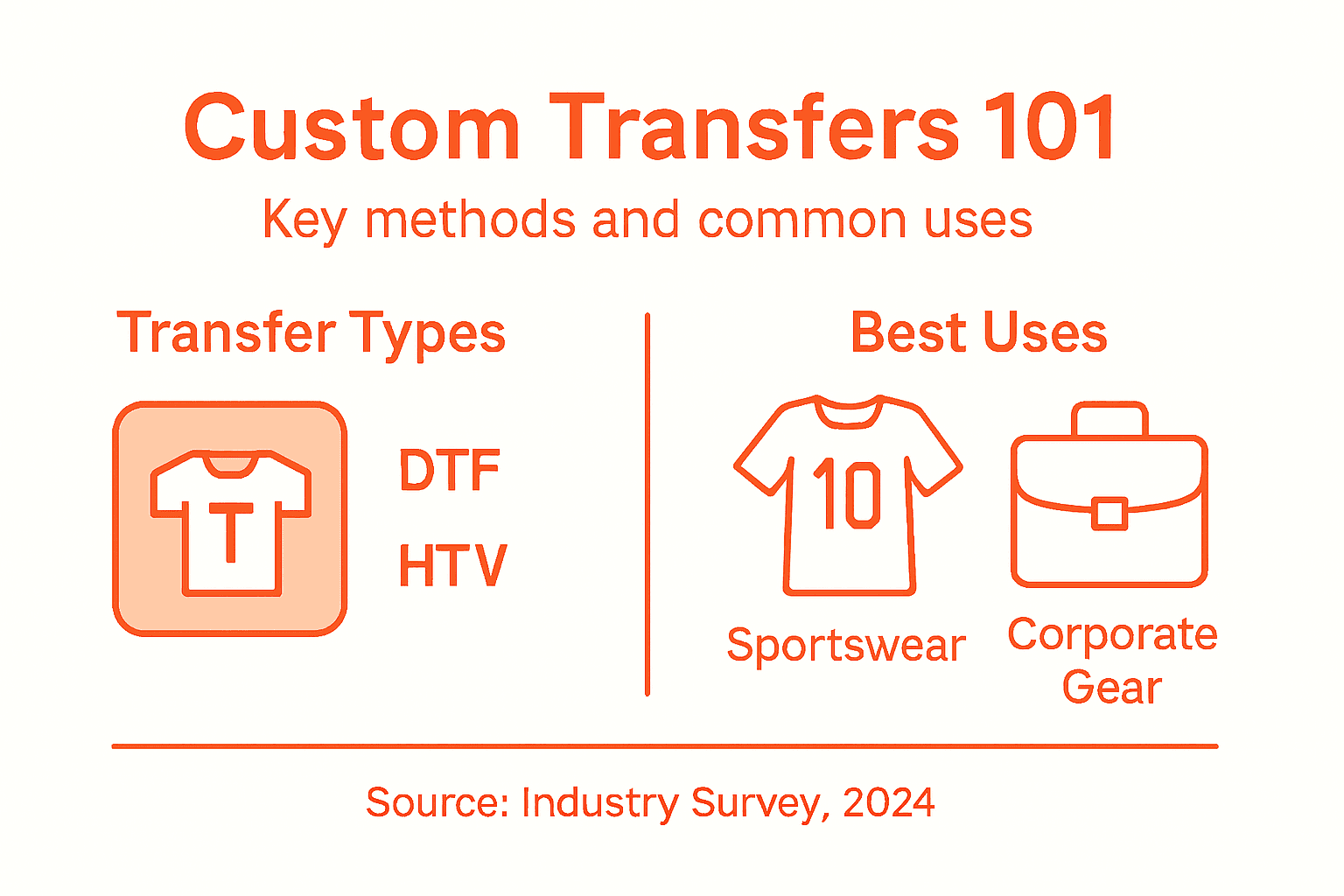
At its core, custom transfers involve printing designs onto a specialized film that can be heat-pressed onto various textile surfaces. This method differs significantly from traditional screen printing or direct-to-garment techniques by offering more flexibility and detail. Key characteristics of custom transfers include:
- High-resolution image reproduction
- Support for intricate multi-color designs
- Compatibility with multiple fabric types
- Minimal setup requirements
- Cost-effective for small to medium print runs
The process begins with digital artwork creation, followed by printing the design onto a transfer film using specialized Direct-to-Film (DTF) printing equipment. Unlike older transfer methods, modern DTF technology allows for stunning color accuracy and sharp details that closely match the original digital design.
Versatility is another hallmark of custom transfers. Businesses can use this technique for everything from corporate merchandise and sportswear to personalized promotional items and small-batch fashion collections. The low barrier to entry makes it particularly attractive for emerging brands and independent creators.
Pro tip: Always select high-quality transfer films and ensure your heat-press settings match the specific fabric type for optimal transfer durability and appearance.
Types of Custom Transfers for Businesses
Custom transfers offer businesses multiple printing options tailored to specific needs and budget constraints. DTF transfer workflows have revolutionized how companies approach apparel customization, providing flexible solutions across different production scales.
The primary types of custom transfers include:
-
Direct-to-Film (DTF) Transfers
- Full-color design capabilities
- Works on multiple fabric types
- Ideal for complex, detailed graphics
-
Heat Transfer Vinyl (HTV) Transfers
- Best for single-color or simple designs
- Excellent for sports jerseys and team uniforms
- Highly durable for active wear
-
Sublimation Transfers
- Perfect for polyester fabrics
- Allows full-color photographic prints
- Permanent, no-crack design integration
-
Screen Printed Transfers
- Cost-effective for large batch orders
- Thick, opaque design appearance
- Works well with cotton fabrics
Each transfer type presents unique advantages depending on the specific business requirements. Screen printing transfers work best for high-volume production runs, while DTF transfers offer unparalleled design flexibility and color reproduction.
Choosing the right transfer method depends on several critical factors including fabric composition, design complexity, budget, and intended use of the final product. Small businesses might prefer DTF for its versatility, whereas larger manufacturers could lean towards screen printed transfers for bulk production efficiency.
Here’s a side-by-side comparison of popular custom transfer types for apparel businesses:
| Transfer Type | Best Use Case | Main Strength | Typical Limitation |
|---|---|---|---|
| Direct-to-Film (DTF) | Complex, high-color graphics | Color precision | Needs special film |
| Heat Transfer Vinyl | Team uniforms, bold logos | Long-lasting durability | Limited to simpler designs |
| Sublimation | All-over photo prints | No-fade color results | Only works on polyester |
| Screen Printed | Large-volume cotton orders | High production speed | Less detailed in fine designs |
Selecting the appropriate transfer type can significantly impact your product’s quality, production cost, and overall customer satisfaction.
Pro tip: Always request sample transfers and test different techniques before committing to a large production run to ensure optimal results and design compatibility.
How Custom Transfers Streamline Production
Custom transfers have become a game-changing solution for businesses looking to optimize their apparel production workflows. Custom transfer techniques dramatically reduce manufacturing complexity and enable faster, more efficient design implementation across various product lines.
The key production advantages of custom transfers include:
-
Rapid Prototyping
- Quick design turnaround times
- Minimal setup requirements
- Low initial investment costs
-
Inventory Management
- Reduced material waste
- On-demand printing capabilities
- Flexible small and large batch production
-
Design Flexibility
- Easy design modifications
- No extensive retooling needed
- Multiple color and fabric compatibility
Scalability represents another critical benefit of custom transfer technologies. Small businesses can now produce professional-quality merchandise without massive upfront equipment investments, while larger manufacturers can quickly adapt designs and production volumes.
The production workflow typically follows a streamlined sequence: digital design creation, transfer printing, heat application, and quality control. This process eliminates many traditional manufacturing bottlenecks, allowing businesses to respond rapidly to market demands and customer preferences.
Custom transfer technologies transform production from a complex, time-consuming process into a flexible, responsive manufacturing approach.
Pro tip: Invest in high-quality digital design software and maintain a systematic workflow to maximize the efficiency gains provided by custom transfer technologies.
Benefits of Outsourcing Transfer Printing
Outsourcing transfer printing has emerged as a strategic solution for businesses seeking to optimize their apparel production capabilities. Transfer print workflows enable companies to leverage specialized expertise without substantial equipment investments.
The primary advantages of outsourcing transfer printing include:
-
Cost Management
- Eliminate expensive equipment purchases
- Reduce maintenance and training expenses
- Convert fixed costs to variable expenses
-
Technical Expertise
- Access professional-grade printing technologies
- Benefit from specialized industry knowledge
- Receive consistently high-quality transfers
-
Production Flexibility
- Scale production instantly
- Handle varying order volumes
- Minimize inventory and equipment overhead
Strategic Focus represents another critical benefit of outsourcing transfer printing. By delegating technical production processes, businesses can concentrate on core competencies like design, marketing, and customer relationships. Small apparel brands and print shops can particularly benefit from this approach, gaining access to professional-grade transfers without significant capital investments.
Outsourcing eliminates numerous operational challenges associated with in-house printing. Companies no longer need to invest in expensive equipment, manage complex maintenance schedules, or continuously train staff on evolving printing technologies. This approach transforms printing from a potential operational burden into a streamlined, efficient service.
Outsourcing transfer printing converts technological complexity into a manageable, predictable business expense.
Pro tip: Carefully evaluate potential transfer printing partners by requesting sample work, checking turnaround times, and confirming their quality control processes before committing to a long-term partnership.
Common Mistakes When Ordering Transfers
Navigating the world of custom transfers can be tricky, with several potential pitfalls that can compromise your final product. Transfer ordering strategies require careful attention to detail to ensure optimal results.
The most frequent mistakes businesses encounter include:
-
Design File Errors
- Submitting low-resolution images
- Using incorrect color modes
- Failing to check design file compatibility
-
Technical Specification Mistakes
- Incorrect fabric type selection
- Misunderstanding transfer application requirements
- Overlooking heat press temperature guidelines
-
Order Preparation Oversights
- Not providing precise quantity specifications
- Neglecting to specify transfer size
- Skipping quality control checks before bulk ordering
Color Matching represents a critical challenge that many businesses underestimate. Digital designs often appear differently when transferred to fabric, leading to unexpected results. Experienced transfer providers recommend creating color test samples and reviewing them under various lighting conditions to ensure accurate reproduction.
Many businesses also fail to communicate specific requirements clearly. Detailed instructions about fabric type, transfer placement, and desired finish can dramatically improve transfer quality. Vague or incomplete specifications frequently result in multiple reprints, increased costs, and potential customer dissatisfaction.
Use this quick overview to avoid costly custom transfer ordering mistakes:
| Mistake Area | Common Pitfall | Impact on Results |
|---|---|---|
| Artwork Submission | Low-resolution or wrong format | Blurry or inaccurate images |
| Technical Details | Incorrect temperature/fabric | Poor adhesion or unwanted textures |
| Communication | Incomplete order instructions | Delays, reprints, increased costs |
Precision in communication and preparation prevents poor transfer performance and wasted resources.
Pro tip: Always request a sample transfer and conduct a test press before committing to a large production run to validate design quality and transfer compatibility.
Simplify Your Apparel Printing with Expert DTF Transfers
If you are navigating the challenges of producing high-quality custom transfers, you already know how crucial it is to balance precision, color vibrancy, and efficiency. Managing the complexities of Direct-to-Film transfers can be costly and demanding, especially when facing issues like intricate design reproduction, heat press settings, and fabric compatibility. At DIY Printz, we understand these pain points and offer a reliable, hassle-free solution to help you focus on growing your brand instead of equipment maintenance or technical setbacks.
Discover how outsourcing your DTF transfer printing to a trusted partner can streamline your production process with consistent, ready-to-press transfers produced in high volumes every month. Whether you run a print shop, create merch, or craft custom apparel, our expert team delivers vibrant, durable transfers that meet your exact specifications. Visit DIY Printz today to unlock the benefits of professional transfer printing without the learning curve or heavy investment. Ready to simplify your workflow and boost profitability? Start your order now and experience a faster, cleaner way to print custom apparel at DIY Printz.
Learn more about how our custom DTF transfers and transfer print workflows can transform your apparel printing process.
Frequently Asked Questions
What are custom transfers in apparel printing?
Custom transfers are a printing method that involves printing designs onto a specialized film, which is then heat-pressed onto various textiles. This technique offers high-resolution image reproduction, supports intricate multi-color designs, and is compatible with multiple fabric types.
What are the different types of custom transfers available?
The main types of custom transfers include Direct-to-Film (DTF) transfers, Heat Transfer Vinyl (HTV) transfers, Sublimation transfers, and Screen Printed transfers. Each type has its unique advantages tailored to specific fabric compositions and design complexities.
How do custom transfers streamline the apparel production process?
Custom transfers simplify production by enabling rapid prototyping, reducing material waste, and offering design flexibility. This results in faster turnaround times and the ability to quickly respond to customer demands with on-demand printing capabilities.
What common mistakes should I avoid when ordering custom transfers?
Common mistakes include submitting low-resolution design files, incorrect fabric type selection, and vague order specifications. Clear communication and attention to detail in your order preparation are essential to ensure high-quality transfer results.
Recommended
- What Are Transfer Prints? Outsourcing DTF for Brands – DIYPRINTZ
- 7 Practical Examples of DIY Apparel Printing for Brands – DIYPRINTZ
- Why Use DTF Transfers for Apparel Success – DIYPRINTZ
- DIY Transfers for Apparel – Why Invest Now – DIYPRINTZ
- The Facts About Custom Gear You Need to Know - Combatra
- Sublimation Terminology – Key Concepts for Small Businesses – SubliBlanks Limited
READY TO PRINT?
Send us your artwork and we'll dial in your DTF transfer, color, and same-day turnaround.


