

Transfer Films Explained: Boosting Apparel Production
Transfer films: discover their definition, types, how DTF transfers work, misconceptions, real-world uses, cost factors, and comparison to alternatives.

Finding the best way to print vibrant designs onto apparel can leave independent brands and DIY creators feeling stuck between expensive equipment and limited results. The growing demand for direct-to-film transfers comes from their ability to consistently deliver colorful, long-lasting graphics without complex machinery or high costs. This introduction breaks down transfer films, their core technology, and what makes them a smart, practical choice for anyone wanting to simplify and upgrade custom apparel production.
Table of Contents
- Transfer Films: Core Definition And Fundamentals
- Types Of Transfer Films And Key Distinctions
- How Direct-To-Film Transfers Work
- Common Misconceptions About Transfer Films
- Real-World Apparel And Merch Applications
- Financial Implications And Alternatives Compared
Key Takeaways
| Point | Details |
|---|---|
| Transfer Films Enable Versatile Apparel Decoration | These films allow for high-quality, durable graphic transfers across various fabric types, enhancing design possibilities. |
| Types of Transfer Films Cater to Specific Needs | Understanding the differences between hot-peel, cold-peel, and specialty films is essential for optimal application selection. |
| Direct-to-Film Printing Revolutionizes Graphic Transfer | This process supports complex designs while minimizing limitations found in traditional printing methods. |
| Cost-Effectiveness of Transfer Films Benefits Small Brands | Transfer films provide low startup costs and reduce financial barriers, allowing small businesses to experiment and scale efficiently. |
Transfer Films: Core Definition and Fundamentals
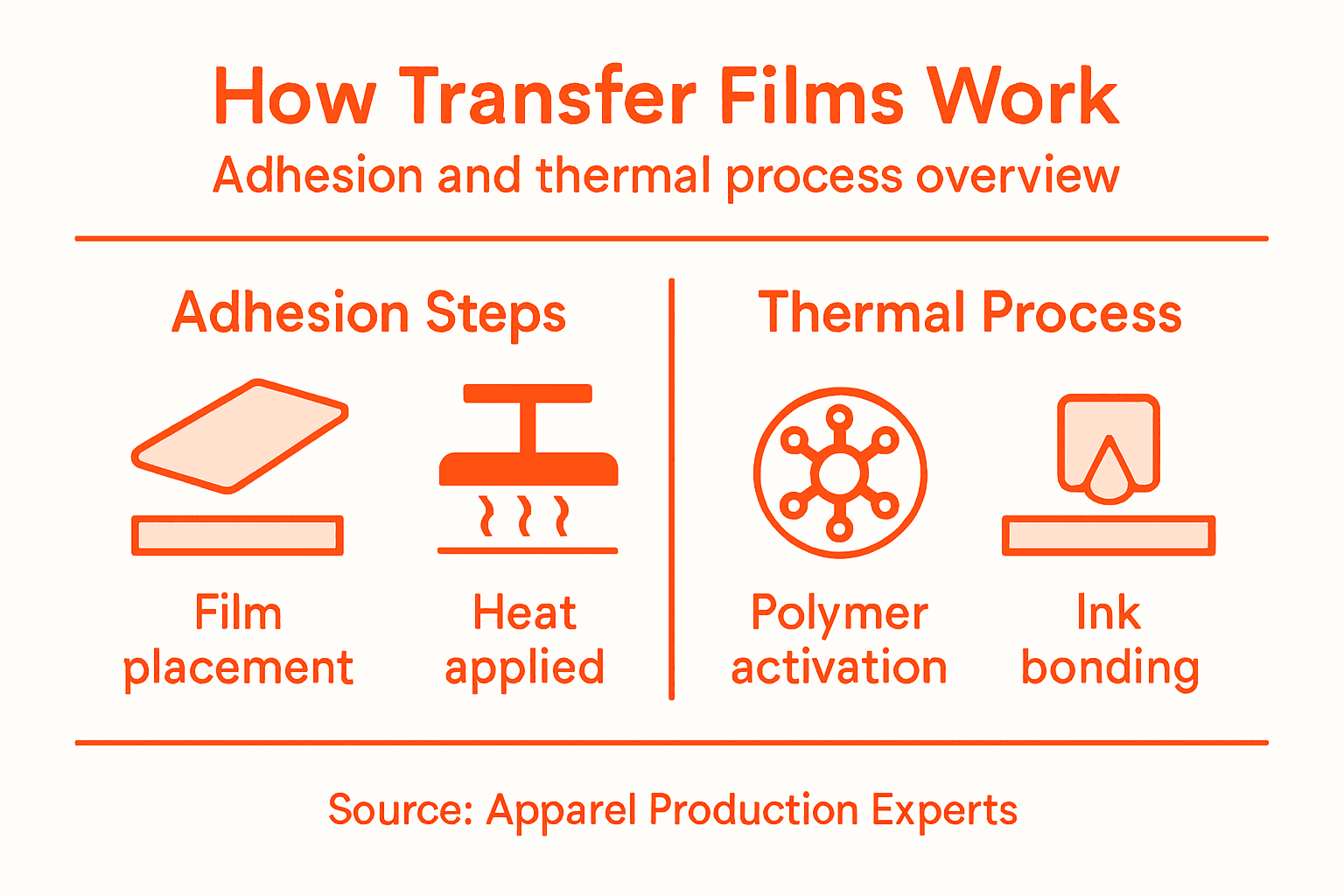
Transfer films represent a critical innovation in apparel production, enabling designers and manufacturers to transform digital artwork into vibrant, durable textile decorations. These specialized polymer-based materials serve as precision carriers that transport printed designs from a source film directly onto fabric surfaces through controlled heat and pressure applications.
At their core, transfer films are thin, uniform layers engineered to facilitate graphic migration between different substrates. Polymer material interactions determine the film’s performance, with key characteristics including:
- Uniform ink-holding capacity
- Precise design transfer capabilities
- Temperature-responsive adhesive properties
- Compatibility with multiple fabric types
The fundamental mechanism involves printing high-resolution graphics onto these specialized films, which then act as intermediary vehicles for transferring designs. When heat and pressure are applied, the film’s adhesive layer bonds the printed image permanently onto textiles, creating crisp, wash-resistant decorations that maintain color vibrancy and structural integrity.
The scientific principles underlying transfer films involve complex adhesion and thermal transfer mechanisms, where polymer coatings interact dynamically with fabric surfaces. This process requires precise calibration of temperature, pressure, and material compatibility to ensure optimal graphic transfer and garment durability.
Pro tip: Always perform a test transfer on a similar fabric swatch to confirm temperature settings and design quality before full production runs.
Types of Transfer Films and Key Distinctions
Transfer films are not a one-size-fits-all solution in apparel production. Different types of transfer films have been developed to address specific design requirements, fabric compositions, and production challenges. Understanding these distinct transfer film variations is crucial for selecting the optimal film for your specific apparel printing needs.
The primary categories of transfer films can be categorized based on several key characteristics:
-
Hot-Peel Transfer Films
- Designed for immediate removal after heat application
- Best for intricate, multi-colored designs
- Minimal cooling time required
-
Cold-Peel Transfer Films
- Require cooling before film removal
- Provide stronger adhesion
- Ideal for high-durability graphic applications
-
Specialty Substrate Transfer Films
- Engineered for specific fabric types
- Includes films for:
- Performance athletic wear
- Stretch fabrics
- Delicate materials
- Synthetic blends
Each transfer film type presents unique advantages depending on the specific production requirements. Factors such as fabric composition, design complexity, intended garment use, and washing expectations play critical roles in film selection. Professional apparel manufacturers often maintain an inventory of multiple film types to accommodate diverse design and production scenarios.
Use this summary to match transfer film types to common apparel applications:
| Transfer Film Type | Best Apparel Uses | Key Benefit |
|---|---|---|
| Hot-Peel | Fashion, custom streetwear | Fast production for detail |
| Cold-Peel | Sports uniforms, workwear | Superior durability |
| Specialty Substrate | Athletic gear, delicate fabrics | Precise fit for unique textiles |
The selection process involves carefully evaluating film characteristics like ink absorption, heat resistance, adhesive properties, and overall compatibility with target fabric substrates. Matching the right transfer film to your specific design and fabric ensures optimal graphic transfer, durability, and visual appeal.
Pro tip: Always conduct small-batch test transfers to validate film performance across different fabric types before committing to large-scale production runs.
How Direct-to-Film Transfers Work
Direct-to-Film (DTF) printing represents a revolutionary technique in apparel decoration, offering unprecedented flexibility and quality for designers and manufacturers. Digital printing technology enables intricate graphic transfers that were previously challenging or impossible with traditional methods.
The DTF transfer process involves several precise technical stages:
-
Digital Design Preparation
- Create high-resolution digital artwork
- Optimize graphics for transfer compatibility
- Select appropriate color profiles
-
Printing Stage
- Print design onto specialized PET transfer film
- Use CMYK color model with white underbase
- Ensure precise ink laydown and color accuracy
-
Powder Application
- Evenly distribute adhesive powder
- Cover wet ink completely
- Ensure uniform powder coverage
-
Curing Process
- Apply controlled heat to set powder
- Create permanent bond between ink and adhesive
- Prepare transfer for fabric application
The actual transfer mechanism involves precise heat and pressure application. When the prepared film is placed against the fabric and subjected to controlled temperature and pressure, the design migrates seamlessly from the carrier film onto the textile surface. This process ensures vibrant color reproduction, exceptional durability, and minimal fabric distortion.
Professional apparel producers appreciate DTF transfers for their ability to handle complex, multi-colored designs across diverse fabric types. The technology eliminates many limitations associated with traditional screen printing, enabling more creative and cost-effective production approaches.
Pro tip: Invest in a professional-grade heat press with accurate temperature controls to ensure consistent and high-quality transfer results.
Common Misconceptions About Transfer Films
Transfer film technology has dramatically evolved, challenging many long-standing perceptions about graphic decoration in apparel production. Screen-printed transfer misconceptions persist among designers and manufacturers, often preventing them from exploring this versatile printing method.
Several common myths about transfer films continue to circulate within the industry:
-
Myth: Transfer Films Feel Plasticky
- Modern films offer soft, flexible finishes
- Advanced adhesive technologies eliminate stiff textures
- Designs integrate seamlessly with fabric
-
Myth: Complex Machinery Required
- Basic heat presses can handle most transfers
- Minimal equipment investment needed
- Accessible for small businesses and large manufacturers
-
Myth: Limited Design Options
- Supports intricate multi-color graphics
- High-resolution image reproduction possible
- Works across diverse fabric types
Professional apparel producers understand that transfer film technology has transcended its historical limitations. Today’s solutions provide remarkable versatility, enabling designers to create complex, vibrant graphics with unprecedented ease and affordability. The key lies in understanding the nuanced capabilities of contemporary transfer film systems.
Technological advancements have systematically dismantled traditional barriers, transforming transfer films from a niche printing technique into a mainstream production method. Manufacturers can now achieve professional-grade results with minimal specialized knowledge, making graphic decoration more accessible than ever before.
Pro tip: Request sample transfer films from manufacturers to personally verify texture, durability, and visual quality before committing to large production runs.
Real-World Apparel and Merch Applications
Transfer film technologies have revolutionized graphic decoration across multiple industries, offering unprecedented flexibility in producing durable apparel designs. From small independent brands to large corporate merchandise programs, these innovative printing solutions enable businesses to transform creative concepts into wearable art with remarkable precision.
The diverse real-world applications of transfer films span multiple sectors:
-
Sports and Athletic Wear
- Performance jerseys
- Team uniforms
- Custom athletic gear
- Training equipment branding
-
Corporate and Professional Apparel
- Work uniforms
- Company branded merchandise
- Professional event attire
- Safety workwear with logo integration
-
Fashion and Retail
- Limited edition clothing lines
- Custom designer collections
- Boutique merchandise
- Personalized streetwear designs
Small businesses and entrepreneurial creators particularly benefit from transfer film technologies. The ability to produce short runs with complex, vibrant graphics eliminates traditional screen printing limitations. Designers can now experiment with intricate multi-color designs, photorealistic images, and unique artistic expressions without massive upfront investment.
Manufacturers across industries recognize transfer films as a game-changing technology that democratizes graphic decoration. Small indie brands can now compete visually with larger production houses, creating professional-quality merchandise with minimal equipment and technical expertise.
Pro tip: Experiment with transfer film samples on different fabric types to understand how design complexity and color vibrancy translate across various materials.
Financial Implications and Alternatives Compared
Choosing the right graphic decoration method involves carefully evaluating the financial landscape of various printing technologies. Transfer films represent a strategic solution that balances initial investment, production flexibility, and long-term cost-effectiveness for apparel businesses of all sizes.
A comprehensive financial comparison reveals several key economic considerations:
Here’s a quick comparison of major apparel printing methods and their key business impacts:
| Printing Method | Startup Cost | Design Flexibility | Suitable For |
|---|---|---|---|
| Transfer Film | Low to moderate | Complex, multi-colored designs | Small & medium runs |
| Screen Printing | High | Limited colors per run | Large batch orders |
| Direct-to-Garment (DTG) | Moderate | Photorealistic images | Short runs, customization |
| Sublimation | Moderate to high | Only on light poly fabrics | Sports & corporate wear |
-
Initial Equipment Costs
- Screen printing: High startup expenses
- DTG printing: Moderate equipment investment
- Transfer film printing: Low to moderate entry point
- Sublimation: Specialized equipment required
-
Per-Unit Production Expenses
- Minimal setup costs for small runs
- Reduced labor requirements
- Lower material waste percentages
- Scalable pricing models
-
Long-Term Financial Advantages
- Reduced inventory holding costs
- Faster design iteration
- Lower minimum order quantities
- Decreased equipment maintenance expenses
Small to medium-sized apparel brands particularly benefit from transfer film technologies. The ability to produce limited edition runs without significant upfront investment allows for more agile business models. Entrepreneurs can test market concepts, create custom merchandise, and respond quickly to emerging trends without committing substantial financial resources.
Economic flexibility remains the most compelling argument for transfer film printing. Unlike traditional methods that require large minimum orders or expensive equipment, this approach democratizes graphic production, enabling creators to experiment and scale their businesses with minimal financial risk.
Pro tip: Calculate your potential return on investment by comparing transfer film production costs against traditional printing methods, considering setup expenses, per-unit pricing, and design flexibility.
Simplify Your Apparel Production with Expert Transfer Film Solutions
The complexity of choosing the right transfer film and mastering Direct-to-Film printing can be overwhelming. From balancing fabric compatibility to ensuring vibrant, durable designs without headaches around equipment cost and maintenance the challenges are real. If you’re looking to enjoy crisp, colorful transfers and avoid the pitfalls of expensive printers or unpredictable print runs then outsourcing to a professional partner is the answer.
DIY Printz understands the need for reliable, high-quality DTF transfers that streamline your workflow and free you from the hassles of daily printer upkeep. We produce hundreds to thousands of orders each month delivering consistent results ready to press on your apparel. Whether you are a print shop, merch brand, or embroidery business our service offers the perfect bridge between innovative transfer films and your production goals.
Take advantage of expert transfer film printing with fast turnaround and no specialized equipment investments. Visit DIY Printz to learn how our ready-to-use DTF transfers can boost your apparel production today. Explore more about Direct-to-Film printing and start simplifying your process with trusted quality you can count on.
Frequently Asked Questions
What are transfer films and how do they work?
Transfer films are specialized polymer-based materials used to transfer printed designs onto fabric surfaces. They act as carriers for high-resolution graphics, which, when subjected to heat and pressure, bond permanently to textiles, resulting in vibrant and durable decorations.
What types of transfer films are available and how do they differ?
There are several types of transfer films, including hot-peel, cold-peel, and specialty substrate films. Hot-peel films allow for immediate removal after heat application, making them suitable for intricate designs. Cold-peel films require cooling for stronger adhesion, ideal for high-durability applications. Specialty films cater to specific fabric types like stretch or delicate materials.
What is Direct-to-Film (DTF) printing and what are its benefits?
Direct-to-Film (DTF) printing is a technique that allows for intricate graphic transfers using digital printing technology. It offers flexibility in design, supports complex multicolor graphics, and is applicable to various fabric types, eliminating limitations found in traditional screen printing.
How does the cost of transfer films compare to other printing methods?
Transfer films generally have a low to moderate startup cost and are ideal for small to medium runs. Compared to methods like screen printing, which has high initial expenses, or Direct-to-Garment (DTG) printing, which requires moderate investment, transfer films offer greater flexibility and reduced long-term costs due to minimal setup and labor expenses.
Recommended
READY TO PRINT?
Send us your artwork and we'll dial in your DTF transfer, color, and same-day turnaround.


