

Essential maintenance guide for durable custom prints & DTF
Learn how to extend the life of your custom prints and DTF transfers with expert fabric selection, wash care routines, and troubleshooting tips for apparel brands.

You’ve invested in quality DTF transfers, pressed them perfectly, and handed off a finished garment you’re proud of. Then, three washes later, the print is cracking at the edges. Sound familiar? The frustrating truth is that print failure rarely comes down to the transfer itself. Most premature fading, peeling, and washout happens because of what comes after the press: fabric choice, wash routines, and daily handling habits. This guide gives you the exact steps to protect your custom prints, extend their life, and reduce costly reprints, whether you’re running a small merch brand or fulfilling hundreds of orders a month.
Table of Contents
- Understanding print durability: Beyond the basics
- Fabric and materials: Choosing the foundation for lasting prints
- Washing, drying, and daily care: Critical habits for longevity
- Troubleshooting: Preventing and solving common print problems
- Our take: Real-life lessons from print maintenance pros
- Get next-level results with hassle-free DTF solutions
- Frequently asked questions
Key Takeaways
| Point | Details |
|---|---|
| Durability starts with fabric | Choosing high-density fabrics is the foundation for long-lasting custom prints. |
| Care routines matter | Proper washing and drying can extend print life by up to 40 percent. |
| Test and monitor regularly | Small batch tests reveal problems before they impact your whole inventory. |
| Proactive troubleshooting saves costs | Diagnosing and fixing minor print issues early prevents costly replacements. |
Understanding print durability: Beyond the basics
When we talk about print durability, we mean a print’s ability to resist fading, cracking, and peeling through repeated washes and regular wear. That sounds simple enough, but the variables that drive durability are more layered than most apparel businesses realize.
The most common misconception is that print quality alone determines how long a design lasts. In reality, print durability depends on both technique and ongoing care. You can use the best DTF transfers on the market and still end up with a cracked print in 10 washes if the fabric is wrong or the wash routine is harsh.
Three factors consistently drive print longevity:
- Fabric density and composition: Heavier, tighter-woven fabrics hold ink and adhesive more effectively than thin or loosely woven ones.
- Print method and application: Proper heat press temperature, pressure, and dwell time directly affect how well a transfer bonds.
- Post-press care: Wash temperature, detergent type, and drying method can either protect or destroy a print over time.
Here’s a quick comparison to put this in perspective:
| Print type | Fabric density | Expected wash life |
|---|---|---|
| DTF transfer | >180g (high density) | 50+ washes |
| DTF transfer | <150g (low density) | 20 to 30 washes |
| Screen print | >180g (high density) | 50+ washes |
| Screen print | <150g (low density) | 25 to 35 washes |
| Sublimation | Polyester (>200g) | 60+ washes |
Notice that DTF and screen printing perform similarly when fabric density is matched correctly. The gap shows up when you press onto thin, low-density blanks and then wash them on hot. Knowing how to extend apparel life starts with understanding these relationships before you ever pick up a heat press.
The takeaway here is straightforward: no single factor controls durability. It’s a system. And every weak link in that system shortens the life of your print.
Fabric and materials: Choosing the foundation for lasting prints
Fabric is the single most controllable variable in your print durability equation. You can’t control how a customer washes a garment, but you can control what you press onto.
High-density fabrics, generally those above 180 grams per square meter (g/m²), give DTF adhesive and ink a denser fiber structure to bond with. That bond holds up better under repeated washing and friction. Low-density fabrics, typically below 150g/m², have looser weaves that allow the print layer to flex and separate more easily. High-density fabrics optimize DTF print durability in a measurable way.

Here’s how common fabric types stack up:
| Fabric type | Best print method | Expected print lifetime |
|---|---|---|
| 100% cotton (180g+) | DTF, screen print | 50+ washes |
| Cotton/poly blend (50/50) | DTF, sublimation | 40 to 50 washes |
| 100% polyester (200g+) | Sublimation, DTF | 60+ washes |
| Tri-blend (cotton/poly/rayon) | DTF | 30 to 40 washes |
| Lightweight cotton (<150g) | Screen print only | 20 to 30 washes |
Cotton blends and heavier polyesters tend to outperform lightweight or tri-blend options for print longevity. Tri-blends are popular for their soft feel, but the rayon content can cause adhesion issues with DTF if the press settings aren’t dialed in perfectly.
Before you commit to a new blank supplier or scale a new product line, always choose durable materials by running small batch tests first. Press 5 to 10 garments, wash them 10 to 15 times using your standard care instructions, and inspect for any early signs of cracking or fading. This step takes a few days but saves you from a costly production mistake.
Pro Tip: Run your wash tests at the harshest settings you expect a customer to use, not the ideal settings. If the print survives that, you know it will hold up in the real world.
Also pay attention to fabric finish. Some performance fabrics have moisture-wicking coatings that repel DTF adhesive. Always check with your blank supplier if you’re working with athletic or technical fabrics.
Washing, drying, and daily care: Critical habits for longevity
Even the most durable print on the best fabric will fail early if it’s washed wrong. This is the part of the equation you need to communicate clearly to your customers, and enforce within your own team for samples and returns.
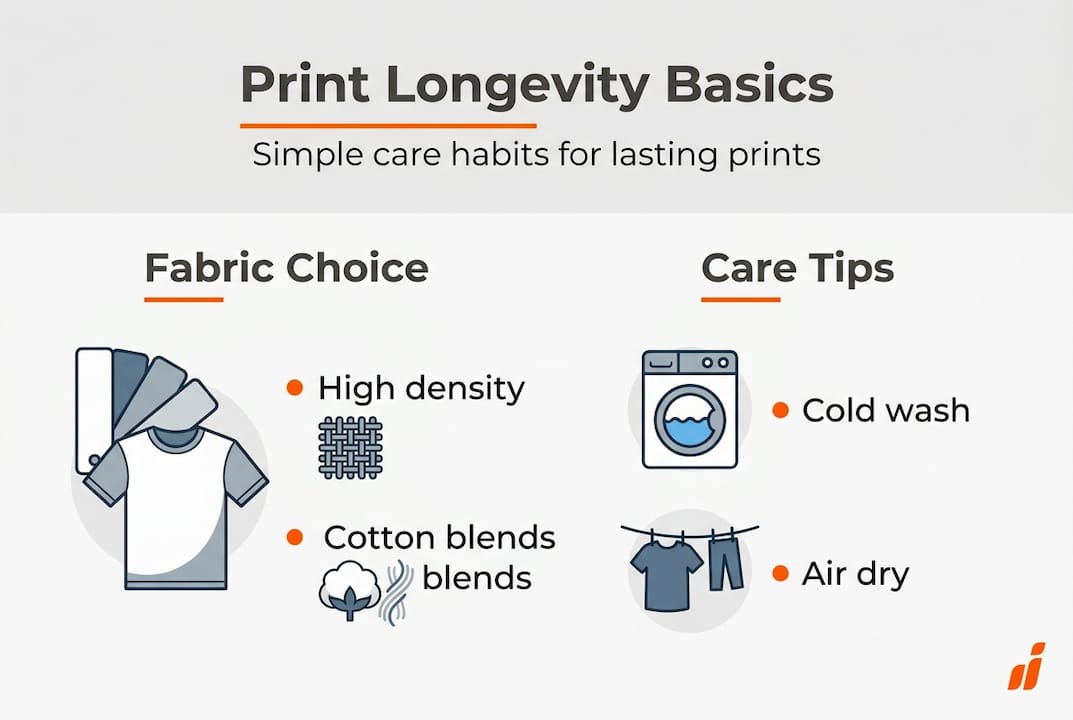
Proper care can extend DTF print apparel life by up to 40%. That’s a significant number, and it comes down to a handful of consistent habits.
Here’s a practical care routine to follow and share:
- Turn garments inside out before washing. This reduces direct friction on the print surface during the wash cycle.
- Use cold water (30°C or below). Hot water breaks down adhesive bonds faster and causes color fading.
- Choose a mild detergent without bleach, optical brighteners, or fabric softeners. These chemicals degrade print layers over time.
- Select a gentle cycle on your washing machine. High-agitation cycles stress the print edges and cause peeling.
- Air-dry when possible. Hang the garment or lay it flat. If you must use a dryer, tumble dry on the lowest heat setting.
- Avoid ironing directly on the print. If pressing is needed, iron inside out or use a pressing cloth.
Pro Tip: Air-drying alone can add 10 to 15 extra washes to your print’s lifespan compared to regular machine drying on high heat.
You can build these steps into your customer-facing care labels and your own apparel care checklist for internal quality control. The brands that communicate care instructions clearly tend to get fewer complaints about print failure, because the customer understands their role in maintaining the product.
For a deeper look at how these habits apply specifically to DTF garments, check out this easy DTF care resource that walks through the full process.
“The difference between a print that lasts 20 washes and one that lasts 60 washes is almost always care, not the transfer itself.”
Troubleshooting: Preventing and solving common print problems
Even with the right fabric and a solid care routine, problems can still surface. Knowing how to diagnose them fast keeps your quality high and your customers happy.
Here are the most common failure symptoms and their root causes:
- Cracking: Usually caused by pressing at too high a temperature or using a low-density fabric that can’t support the print layer.
- Peeling at edges: Often a heat press issue. Uneven pressure, too-short dwell time, or a cold press can leave edges unbonded.
- Fading after a few washes: Typically linked to hot-water washing, bleach use, or a high-agitation cycle stripping the ink.
- Color loss in specific areas: Can indicate inconsistent press pressure or fabric surface irregularities like seams or pockets.
- Washout (full print loss): Usually caused by pressing onto incompatible fabric, especially coated or moisture-wicking materials.
For each of these issues, the fix starts with identifying whether the problem is in the press stage or the care stage. If multiple garments from the same batch fail the same way, it’s almost always a process issue. If failures are scattered across batches, care habits are the more likely culprit.
Testing small batches by fabric type reduces the risk of widespread failures. Don’t wait until you’ve pressed 200 shirts to discover a compatibility issue.
Pro Tip: Keep a simple log for every print batch: fabric type, press temp, dwell time, and wash test results. Patterns in your data will reveal recurring problems faster than guesswork.
For more specific fixes and press settings by fabric type, the DTF troubleshooting tips guide covers the most common scenarios in detail.
Avoid these mistakes that shorten print life:
- Skipping wash tests on new fabric suppliers
- Pressing at a single default temperature for all fabric types
- Ignoring customer complaints about print quality as one-offs
- Storing pressed garments in humid or high-heat environments before shipping
Our take: Real-life lessons from print maintenance pros
Here’s the hard truth most articles won’t say out loud: the businesses that struggle most with print longevity aren’t struggling because of bad transfers or cheap blanks. They’re struggling because maintenance is treated as an afterthought.
We’ve seen it repeatedly. A shop invests in quality DTF transfers, presses them well, and then ships garments with zero care instructions. Or they skip batch testing because they’re in a rush to fulfill an order. The short-term time savings turn into long-term customer complaints and reprints that cost far more than the test would have.
Maintenance isn’t just a checklist. It’s a mindset built into your workflow. The shops that consistently deliver durable prints treat every new fabric source as a variable to test, every care label as a customer education tool, and every failed print as data rather than a fluke.
If you want to go deeper on the hands-on side of this, the hands-on fabric printing process guide is worth your time. Continuous improvement always beats set-it-and-forget-it.
Get next-level results with hassle-free DTF solutions
Applying everything in this guide gets a lot easier when you’re starting with high-quality transfers. Inconsistent transfers create inconsistent results, no matter how good your care routine is.
At DIY Printz, we produce hundreds to thousands of ready-to-press same day DTF transfers every month with consistent quality and fast turnaround. Our Auto Gang Sheet Builder makes it simple to order exactly what you need, in the sizes you need, without waste. When your transfers are reliable, your maintenance efforts actually pay off. Explore the full range of DTF transfer solutions and see how we help apparel businesses press with confidence, every single time.
Frequently asked questions
How can I prevent my custom prints from cracking after a few washes?
Use high-density fabrics above 180g, wash garments inside out on cold water, air-dry when possible, and avoid bleach or harsh detergents that break down the print layer.
How often should I test print batches for quality?
Test every new fabric type or print supplier before scaling, and repeat batch testing quarterly to catch any consistency issues before they reach customers.
What is the most common cause of peeling prints on apparel?
Improper heat pressing and unsuitable fabric choices are the main causes, since print durability depends on both correct technique and compatible materials working together.
Do DTF prints last longer than screen prints?
With the right fabric and care routine, both methods perform similarly. Prioritize high-density fabrics above 180g for DTF to match the wash durability you’d expect from quality screen printing.
Recommended
READY TO PRINT?
Send us your artwork and we'll dial in your DTF transfer, color, and same-day turnaround.


